How to Get Teens Interested in STEM at School

From hands-on experiences to museums and mentors, here are some tips on how to get interested in STEM in school

If you want to nurture your child’s interest in Science, Technology, Engineering, and Mathematics (STEM), it’s important to go beyond the four walls of their classrooms. A report by the National Academies of Sciences, Engineering, and Medicine revealed that only 22 percent of American high school graduates are knowledgeable in these particular subjects. In fact, the chair of the committee stated that students have limited learning experiences that are confined to reading textbooks, passive listening, and memorizing disconnected facts.

That said, the chances are that your teenager probably needs more opportunities if they are to become more interested STEM. So here are some tips that can encourage them to take most interest in STEM subjects:

Show how to apply STEM to real life

It’s hard for your child to gain an interest in STEM if they can’t see why it’s relevant to everyday life. STEM education can be pretty intensive, so the whole process can get a little overwhelming. Thus, it’s important that your child takes a step back and looks at how it is relevant to their day-to-day life.

Digital Learning emphasizes that students must also be given a chance to see the concepts come to life in a real, physical environment. Allowing them to see how robots or even statistical software are developed, which can boost their interest and their confidence in pursuing a career in STEM. The key here is to expose them to experiences that can help them understand its importance.

Provide hands-on learning experiences

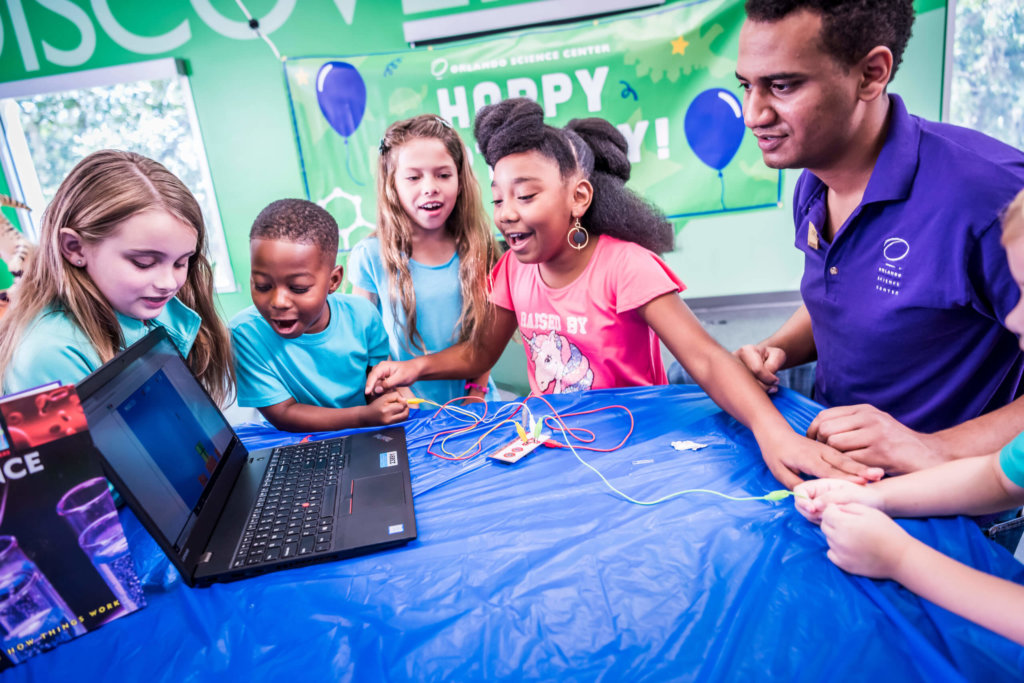
Hands-on learning experiences are very important. STEM experiments and projects provide your child the opportunity to witness firsthand how cool STEM is as they get to deep dive into certain fields.

Education design consultant Karen Aronian looked at how chess incorporates math and logic, which allows kids to learn while also enjoying the challenge of playing board games. On the other hand, they can be introduced to electronics through online resources like Upverter, which is a free, web-based printed circuit board (PCB) design tool. Upverter is the educational and student-friendly version similar to the industry standard design platform Altium 365. Both platforms allow users to design, share, and manufacture electronics all in one place. Through these hands-on activities, your teen can gain first-hand experience in these academic fields.

Take them to exhibits and museums

Another great way to encourage an interest in STEM is by visiting exhibits and museums. These centers not only improve their knowledge regarding STEM subjects, but they can also pique their curiosity when it comes to certain subjects.

Orlando Science Center is a staunch advocate of STEM learning through museums and their exhibits. This is an avenue to introduce teens to new and exciting STEM concepts. For instance, the Flight Lab allows visitors to learn more about aviation through virtual reality simulators. 

Held annually at OSC, Otronicon Interactive Tech Convention has created a rich environment for active STEM learning through hands-on exhibits, tech demonstrations, industry-professional-led workshops and panels, gaming competitions, and much more, connecting Central Florida audiences to industry experts and innovative tech that is driving the future.


Connect your child to a mentor

The teachers in your teen’s school can be the key to igniting their interest in STEM. By connecting them to a mentor, it will enable them to receive career advice which will help them map out a career path in STEM. This is even more significant for girls who want to join male-dominated fields, such as engineering and computer science.

If your child has a good role model in their school, encourage your teen to interact and learn more from this specific teacher. STEM after school clubs are a great place to meet good mentors. They provide them with an opportunity to talk about their interests with like-minded students. This allows their ideas to flourish, further encouraging them to delve deeper with regard to STEM topics.

At the end of the day, your teen will be more interested in STEM if they have opportunities to learn more about the subjects they are interested in. As a parent, you provide support by broadening their exposure to professionals and real-life STEM applications.


Orlando Science Center Member App • Make Reservations and Check In

Calling All OSC Members — Download the Orlando Science Center Member App Today!

This convenience for our members means your Membership Card is available digitally whenever you need it! Making reservations is a breeze and you can find the latest OSC news and updates right at your fingertips!

download on the app store
get it on GooglePlay

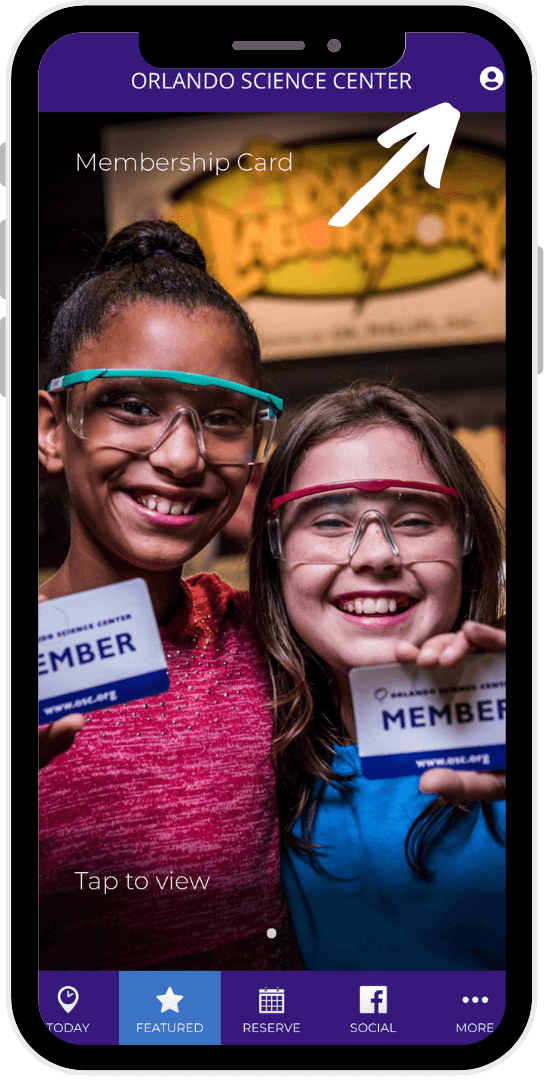
In the Google Play store or Apple store, search "OSC Members" to download the Orlando Science Center Member App. Once you have downloaded and opened the app, tap in the top right, and log in using the same email address you gave us at the time of purchase which is the primary email on your account. 

If you do not have a password, select ‘Forgot login?’ to initiate a password set-up.

Now that you’re logged in, you can view your Membership card by tapping ‘Tap to View’ on the home screen.


The Science Center is currently recommending our Members reserve their visits in advance to guarantee admission and expedite check-in.

Tap the 'Reserve' button at the bottom of the screen to be prompted through the process.

Orlando Science Center Member App home screen

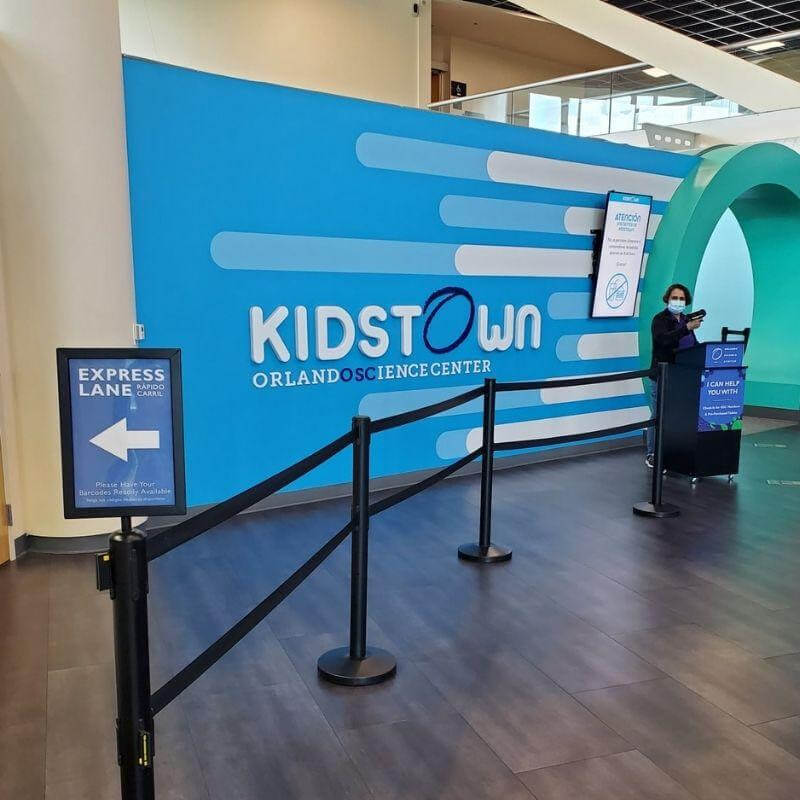
Express Lane for OSC Members!

On your next visit, be sure to take advantage of our Express Lane!

This allows visitors with scannable barcodes to check-in with no need to wait in line at the main Guest Services desk. (Unless you just want to say ‘hi'!)

Express Lane queue for Orlando Science Center Members

3D Printing Assistive Technology • How the Maker Movement is Making A Difference

How open-source 3D printing is changing the world of assistive technology

The concept of 3D printing, or Fused Deposition Modeling (FDM) has actually been around since the early 80s thanks to Dr. Hideo Kodama, with the first 3D printer commercially available in 1986. 3D printing became a revolution in the STEM community with use by engineers, inventors, and even medical professionals when a 3D printed kidney was successfully transplanted to a patient in 1999!

As 3D printing technology became more diverse and affordable, it has continued to gain popularity among scientists, makers, and hobbyists alike. From a 3D printed car to a 3D bioprint of Vincent van Gogh’s ear, it seems creativity is the only limit.


3D printing also increases accessibility with much success in printing casts for broken bones, prosthetic limbs, even wheelchairs that can be customized and created for a fraction of the cost. These are a cost-effective way to keep up with a child as they grow, or damage their current one in the act of being a kid.

Limbitless Solutions, a UCF-based nonprofit organization, dedicated to empowering children through expressive bionic arms at no cost to their families surprises 7-year-old with 3D printed Iron Man prosthetic arm presented by Iron Man himself, a.k.a. Robert Downey Jr.

While it seems almost anything can be 3D printed, it must first be designed and modeled – a process which is often easier said than done. Even that skill is no match for the triumph of the human spirit. Open-source websites have become popular hubs for professionals and makers to freely share their designs.

Websites such as Thingiverse, e-NABLE, and NIH 3D Print Exchange - COVID-19 Supply Chain Response, not only allow designers to help each other improve their work, but makes affordable technology more accessible.

From 3D modeling to soldering a circuit board, The Hive: A Makerspace Presented by The Isaacs Family is one of OSC’s newer exhibits, that focuses on learning new maker skills, as well as new and creative ways to use them. Whether you’re a tech tycoon, or a happy hobbyist, it’s never a bad idea to add another skill to your metaphorical, or literal, toolbelt.

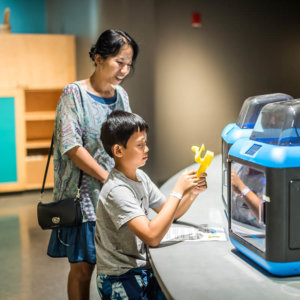
A boy examining a 3D printed object in The Hive.

Learn more about the Maker Movement!

Can Service Dogs Help STEM Professionals?

Learn how service dogs can help people with disabilities breakdown barriers!

Have you ever seen a person using a service animal? Why do some people have animals that help them complete tasks? 

When most people think of service animals, what probably comes to mind is a person who is blind using a seeing-eye dog, but there are a wide variety of disabilities and medical conditions where a service animal can be used to help people.

People who have disabilities sometimes use service animals, like dogs, to help them complete day-to-day tasks easily. Service dogs are specifically trained to help their owners complete tasks they would not be able to do independently; like open a door, bring them their car keys, and even guide a person who is blind across a street. Some dogs can detect when a person’s heart rate lowers, or when they are showing signs of anxiety from previous trauma. The dogs can alert their owners, and they can then take medications they need, prevent an anxiety attack, or get to a safe space away from people.

Service dogs are “tasked trained” meaning there is a specific task or behavior they have been trained to perform to help their owner. This is what separates them from just your average pet dog. Not every person with a disability needs a service dog, but some people can’t imagine trying to live their life without one!

Sierra Middleton was an animal care intern at Orlando Science Center where she helped to clean enclosures, walk animals outdoors, provide a science learning experience for guests, performed water chemistry testing, and learned how to train exotic animals, accompanied by her loyal service dog, Duke. 

To me, Duke is more than just my service dog - he’s my lifeline in a lot of ways. He means an increased quality of life; helping me with things every day as simple as picking up my dropped phone to as great as alerting me to an impending medical episode.

The many ways I have trained him to help mitigate my disabilities have certainly helped me in more ways than I can count, but in all honesty it was the mere existence of his unconditional love that acted as a light at the end of a long, dark tunnel.

Sierra Middleton
OSC Intern & Volunteer
a STEM professional with her service dog

The Americans with Disabilities Act (ADA) was signed into law on July 26, 1990, by President George H.W. Bush. The ADA is one of America's most comprehensive pieces of civil rights legislation that prohibits discrimination and guarantees that people with disabilities have the same opportunities as everyone else to participate in the mainstream of American life -- to enjoy employment opportunities, to purchase goods and services, and to participate in State and local government programs and services. 


Learn More!

Behind the Frames: Student Works from the UCF School of Visual Arts and Design

Behind the Frames presents artwork from students in the Character Animation Track BFA and Animation and Visual Effects Track MFA

The works presented are seldom exhibited preproduction and production images created for the development of graduate and undergraduate animated films produced at the University of Central Florida’s School of Visual Arts and Design. Displayed here are character design sheets, production stills, background paintings and concept sketches from recently released and current projects.

Behind the Frames will be on display in Orlando Science Center's Fusion: A STEAM Gallery on Level 3 from August 28 through November 14, 2021.


Behind the Frames Exhibit Q&A Completed By UCF Lecturer of Animation Jo Anne Adams

What inspired you to curate the pieces in this exhibition?

As a faculty member, I am deeply inspired by the talent our students display and their passion for their medium. Few people understand the scope of artistic development necessary for creation of an animated production. This exhibit offers an opportunity for appreciation of the artistic and technical layers involved in the production process.

What do you hope guests will take away from this exhibition?

I hope to inspire young artists to pursue a discipline that satisfies both the creative and technical problem-solving passions found in the animation field.

How is STEAM (Science, Technology, Art, Engineering, and Math) relevant to this exhibition?

Animation utilizes a broad array of artistic and technical skills. Storytelling requires deep research into literature, history, environments and culture. In development of imagery design theory, film theory and editing theory are all utilized. In order to execute their films, advanced imaging software packages such as Maya, Houdini, Renderman, and Nuke are mastered.

The production process requires not only designers and colorists but coders and rigging artists. Effects artists must study and reinterpret the physics of our world into the worlds they create. Integration with ambient sound, foley and musical scores is achieved through coordination with composers and sound artists. This discipline is attractive to a very particular kind of artist who enjoys being a part of a studio collective.

Behind The Frames artwork by UCF Student , Christina Christie
Hannah Huffman student artwork for Behind the Frames exhibition

Featured Artists: Indianna Alvarez- Sanchez, Erin Bergin, Clinnie Brinson, Isobel Cassidy, James Chambless, Christina Christie, Jamie Dean, Kirstin Hardin, Hannah Huffman, Hannah Jurgens, Clara Kopitnik, Jamie Lachnicht, Nathaniel Shrage,  and Damian Thorn-Hauswirth


The University of Central Florida (UCF) is quickly becoming a prominent institution in the animation field. Both the Character Animation BFA and Animation and Visual Effects MFA tracks allow students to integrate multiple domains of art, storytelling and technology into their body of work. The faculty strives to provide a solid foundation in techniques and theory; a broad understanding of related disciplines including arts, humanities, and technology, and extended experience in working in multidisciplinary teams on realistic problems.

UCF is currently ranked second in the nation on the 2021 list of Top Forty Public Animation Schools and Colleges in the U.S. by Animation Career Review. Their undergraduate program has a strong history of producing award-winning productions and MFA students have presented their research at the annual Society of Animation Studies conference since the MFA’s foundation. Graduates have moved on to work for prestigious film, television, simulation and gaming companies. Alumni have successfully pursued careers such as animators, story artists, visual development artists, lighting artists, technical artists, effects artists, modelers, riggers, or texture artists. The college's faculty and students are dedicated to furthering the art of visual storytelling and further pushing the quality and skill associated with the UCF School of Visual Arts and Design.

How to Turn Leftover Food into a Science Experiment

Whoever said "Don't play with your food" never learned how to turn leftover food into a science experiment

Grab an apron and convert your kitchen into a chemistry lab with ingredients you can find around the house!

From DIY tie-dye to marshmallow molecules, join us as we reduce, reuse, and recycle leftovers and food scraps into some exciting science experiments! 


Science experiments that look good enough to eat!

Science and chill

This (literally) cool fan-favorite science experiment is not only delicious, but dives into the science behind this classic sweet treat. 

Chemistry rocks! 

Check out the chemistry behind candy with this crunchy and colorful creation.

DO play with your food!

Never trust a molecule, they make up everything

This make-a-molecule activity is a great way to introduce little learners to chemistry or and makes a delicious study tool for rising researchers!

Dig in!

If your little learners really DIG dinosaurs, step into the role of paleontologist with a chocolate chip cookie archaeology activity for kids!

Science is sugar, spice, and everything nice

If you need to give your sweet tooth a break, check out what to do with leftover candy! You'll love this sweet take on STEM!

Turn scrap food into science

You don't need a Ph.D. to make your own pH indicators 

Turn your leftover fruits and veggies into natural DIY pH indicators and use them to test the pH of things you find around your home!

Try this DIY tie-dye

Did you know that you could use avocado scraps to make fabric dye at home? Learn how to extract tannin from the pit and skin of avocadoes!

Rise and (coffee) grind!

Real fossils can take 1000s of years to form, but you can make your own in about an hour using coffee grounds

How Digital Technology Helps Healthcare Professionals Treat Patients Through the Internet

What do you get when you put together communication technology and healthcare?

Answer: Telehealth

Telehealth is the use of different devices, like computers, phones, and tablets, to get medical care. It allows doctors, nurses, and patients to communicate through digital means. Telehealth has been growing in popularity since last year. This is mostly because the pandemic forced people to use more digital forms of communication—even in the healthcare sector.

To illustrate, virtual care visits in New York University’s Langone Health Center grew by more than 600% following the pandemic. But even after the pandemic ends, the American Telemedicine Association believes that telehealth services will remain necessary in improving and saving the lives of many Americans. Telehealth is vital for helping both healthcare workers and patients—and here’s why:

Telehealth allows consultations to be more accessible

Apps like Messenger and Zoom are making it possible for everyone to set up virtual calls with people across the globe. Similarly, telehealth apps serve as a video conferencing and messaging platform for healthcare professionals and patients. Through their gadgets, patients can book virtual appointments,

ask for prescription medicines, and share health information with their doctors. And this can all be done remotely, meaning patients in rural locations have better access to quality healthcare services.

Telehealth helps in monitoring patients

 Telehealth also allows doctors and nurses to keep a close eye on their patients, even from a distance. With telehealth apps, patients can fill out forms about their physical state and send them to their healthcare providers. And some devices, like smartwatches, even let doctors monitor a patient's heart rate from miles away. Plus, healthcare professionals continue to improve telehealth services by adding all sorts of new features.

For example, Tata Consultancy Services found out that 86% of healthcare organizations are already using Artificial Intelligence (AI) for their services. Kenneth Stanley, a professor of Computer Science at the University of Central Florida, points out that AI is essential in this practice because it can automate services and provide quicker access to information. Because AI has become more accessible and user-friendly, healthcare professionals are using it to monitor remote patients.

Telehealth assists in healthcare education

 Telehealth is also essential for future healthcare workers, because the Internet makes it possible for them to learn from anywhere in the world. Through telehealth services, medical trainees get to observe and participate in real hospital cases without leaving their homes. These online platforms allow our future healthcare workers to learn from hospital scenarios without getting exposed to dangerous diseases.

This is also why more educational institutions have made it possible for general studies degrees in healthcare to be completed 100% in a virtual environment. The remote learning setup allows aspiring healthcare professionals to acquire essential medical skills through safe and accessible means. Through these online classes, students learn crucial concepts in ethics, medical terminology, informatics, and public health. This is so they have the necessary knowledge once they start working on hospital cases and telehealth-related services.

Telehealth makes it easier to collect and access medical records

The use of telehealth in the medical sector has made it very easy for professionals and patients to access health records. Printed reports and paper forms are a thing of the past. Now, patients can access online portals and communication apps to save and forward important health data. This way, their healthcare providers can easily access the information through their own device and send back their health recommendations.

With telehealth services, both healthcare workers and patients can access important data whenever and wherever they want. Digital technology has improved healthcare services by providing accessibility, convenience, as well as safety. With telehealth, healthcare providers, patients, and even aspiring healthcare workers can easily retrieve and send information—all through an online platform.


Learn More!

Orlando Science Center Reciprocal Membership • Road Trip With Your Membership!

Get FREE or discounted admission to other museums with your Orlando Science Center reciprocal membership!

The ASTC (Association of Science and Technology Centers) Travel Passport Program is one of the top benefits of an Orlando Science Center Membership. Through this reciprocal membership program, you are able to access hundreds of museums and science centers, either at discounted rates or free, with your Orlando Science Center reciprocal membership!

With summer upon us, we wanted to share some eligible Travel Passport participants in Florida for you to check out. You can day trip to these locations in the Sunshine State — meaning you can get there and back again in a day! *We always – always – recommend calling the museum prior to your visit to learn of any restrictions, operating hours, and other details you might need to know before you travel.

2 – 2 ½ HOURS


3 HOURS


3 ½ – 4 HOURS

Check out the full list of ASTC reciprocal museums and science centers!

When visiting Orlando Science Center, please note that your reciprocal membership will provide free admission for two adults and children under 18 living the household or two grandparents and grandchildren under 18.

Free admission is limited to general exhibit areas only. Excludes special events, films, blockbuster exhibits, and free parking. No other discounts apply.

Celebrating a Lifetime of Tradition With Publix Super Markets Charities

Publix Super Markets Charities helps you celebrate another revolution around the sun!

Giving back is something that came easily to Publix Super Markets’ founder, George W. Jenkins. He attributed his success to generously dedicating his time and financial support to several charitable causes and investing in his own employees. Mr. George, as he was affectionately known, was once asked, “If you hadn’t given away so much, how much do you think you’d be worth today?” To which his response was, “Probably nothing.” Publix Super Markets Charities was established in 1966 by the company founder to fulfill his legacy of giving back to the community and has successfully achieved that for decades since its inception.

The depth and breadth of the foundation’s impact is far- reaching and continues to grow. It spurs change and improves the lives of people within the communities in which Publix operates through the support of an array of nonprofit organizations throughout the southeast region. To ensure their philanthropic endeavor of building healthier communities, the foundation focuses its support on initiatives for youth, education, reducing hunger, and alleviating homelessness.

For more than 25 years, Publix Super Markets Charities has been a long-standing partner of Orlando Science Center, helping us meet the STEM learning needs of Central Florida. If you have ever hosted or had the opportunity to attend a birthday party here, you have Publix Super Markets Charities to thank for it. From space exploration and chemistry to paleontology and zoology, we provide live demonstrations, engaging experiments, and encourage creativity during your loved one’s special day. Our birthday party program is made possible through a sponsorship from Publix Super Markets Charities.

a group of kids at a birthday party doing a computer project

Throughout the years, the foundation has helped ensure science learning for everyone through their sponsorship of our accessibility program, Science for All. The Explore It! area in KidsTown, our state-of-the-art early childhood exhibit, was made possible through generous support from Publix Super Markets Charities as part of our Unlock Science campaign.

With their generous support, the Science Center provides unique and engaging STEM learning experiences for children and their families throughout Central Florida. We are very proud to honor Publix Super Markets Charities as a member of our Medallion Society, which is an extraordinary group of our most generous supporters. Medallion Society members are leaders in philanthropy through lifetime gifts of $1 million or more benefiting our mission to inspire science learning for life.

STEM learning is critical to community prosperity. Publix Super Markets Charities serves an important role in our ability to impact children and their families. We are grateful for our longtime partnership and proud to honor them as a member of our Medallion Society. 

JoAnn Newman
President & CEO of Orlando Science Center
a little girl digging up fake dinosaur bones

Dedication and support from the foundation enables us to continue providing innovative and engaging learning experiences to help our community grow and prosper. Learn more about Publix Super Markets Charities and its impact today. 

Can Snakes Be Venomous AND Poisonous?

Are snakes venomous or poisonous? Can some snakes be venomous and poisonous?

Florida is home to 44 different snake species, from the large and dramatic eastern indigo snake, to the teeny tiny ringneck. All of our serpentine friends, even the venomous ones, serve important roles in our ecosystem by helping to regulate rodent populations, and by providing food to larger predators. Notice, we said venomous snakes, not poisonous ones. That’s because venom and poison aren’t the same things. But can some snakes be both venomous and poisonous?

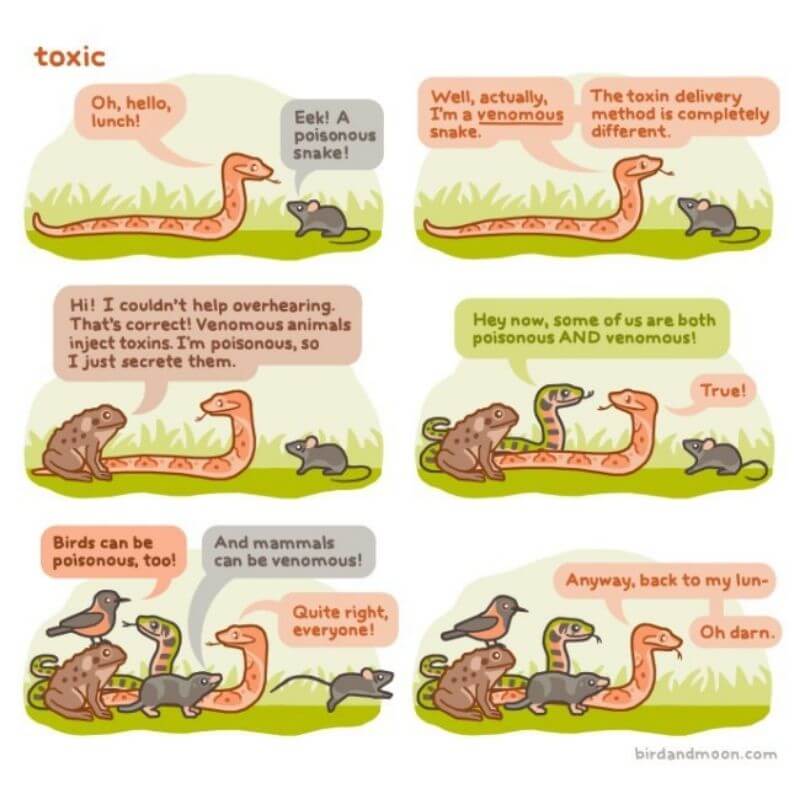
First, let's break down what it means to be venomous versus poisonous. Both venom and poison are toxins, which means they can cause harm to our bodies. The difference between venom and poison is how the toxin gets into a body. Poison is either eaten or touched, like poison ivy or arsenic. Those can only hurt you if you put them in your mouth or on your skin. Venom, on the other hand, is injected. Think of the fangs of a snake or the stinger of a scorpion. Venomous animals must puncture the skin of their victims to get their venom into the victim’s blood. 

 While unusual, there are a few species of snake that are actually poisonous. Rhabdophis keelback snakes are both venomous and poisonous – their poisons are stored in nuchal glands and are acquired by sequestering toxins from poisonous toads the snakes eat. Similarly, certain garter snakes from Oregon can retain toxins in their livers from ingesting rough-skinned newts.

Of these 44 different species of snakes that call Florida home, only six are dangerous to people, those being:

  • Eastern coral snake
  • Southern copperhead
  • Cottonmouth
  • Eastern diamondback rattlesnake
  • Timber rattlesnake
  • Dusky pygmy rattlesnake

That all sounds pretty scary, but don’t worry! It’s actually very unlikely to be bitten by a snake in the state of Florida. In fact, it is much more likely for a person to be struck by lightning than to be bitten by a venomous snake! This is because snakes want nothing to do with people. They usually are very likely to flee at the first sight of a person. They don’t want to end up as a larger animal’s dinner after all!

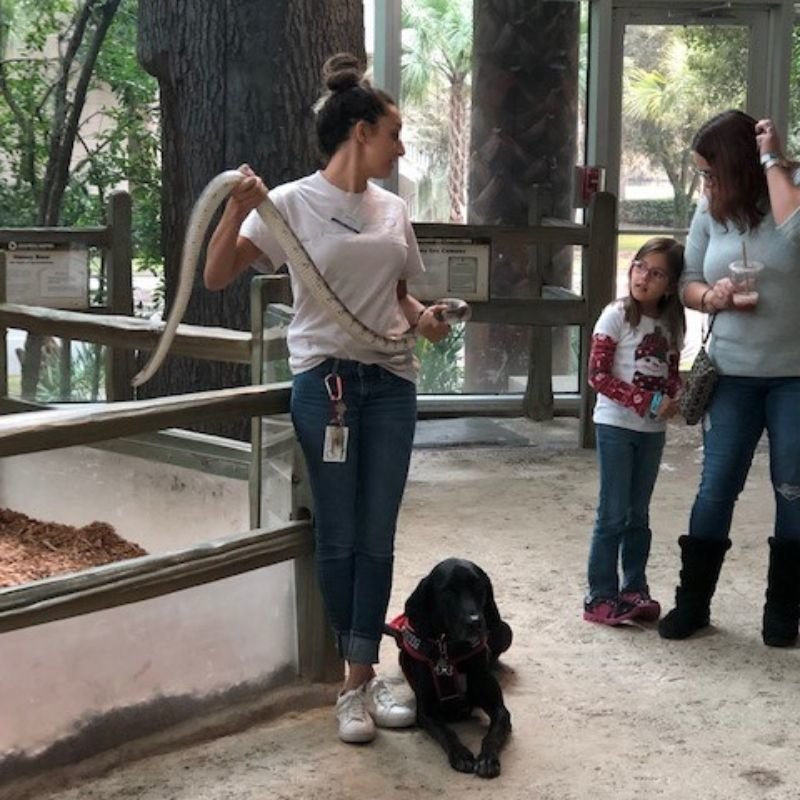
Can Snakes Be Venomous and Poisonous

Unfortunately, the majority of reported snake bites are due to handling snakes or even trying to hurt them. If you’re still concerned about snakebites, educate yourself and family about them, make sure not to reach into dense bushes where you can’t see your hands, and seek out snake avoidance training for your pets. Fortunately, even those who do get bitten are almost always fine, as long as they seek out medical attention immediately. Snake venom has been heavily researched by medical scientists for creating new highly effective medicines.

Take a few minutes to find out which venomous and nonvenomous Florida snakes are your favorites, and see which ones you can find in NatureWorks next time you slither into Orlando Science Center!