





Exhibits
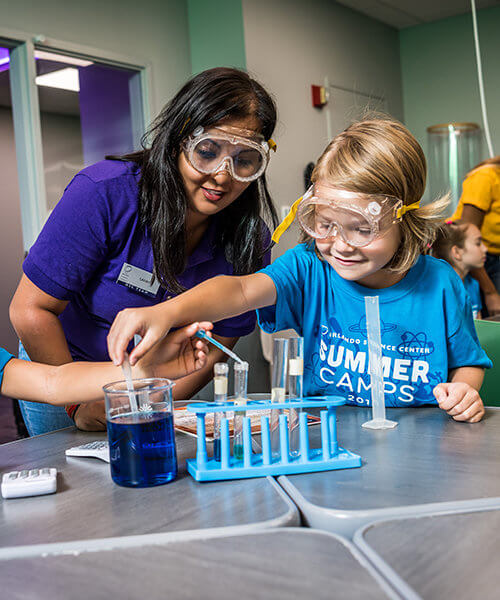
Orlando Science Center's exhibit halls feature a vast array of exciting interactive experiences! Learning has never been so fun with these hands on educational exhibits. From down to earth explorations in natural science to the high-tech world of simulation technology, everywhere you look, you'll find educational and entertaining opportunities to explore, experiment, and discover.
Traveling Exhibits
The Orlando Science Center is home to some of the most exciting traveling exhibits in the country. Upcoming traveling exhibits at the Science Center include Blue Man Group – Making Waves and Adventures With Clifford: The Big Red Dog. When these exhibits are in town they are only here for a limited time; so don’t miss the opportunity to see them!
Exhibit Halls
As great as our traveling exhibits are, there are some exhibits that are the staple of the Orlando Science Center. NatureWorks will have you up close and personal with some of nature’s most fascinating reptiles. At DinoDigs, you’ll step back into the prehistoric age. Discover the dynamic forces and systems that shape our Earth, as well as other planets in Our Planet, Our Universe. Explore such concepts as electricity and magnetism, lasers, soundwaves, and nature’s forces in Science Park. No visit to the Science Center is complete without a trip to KidsTown, an interactive world dedicated to our smaller explorers.
Science Live! Programs
What’s the difference between a great visit to a Science Center and a memorable visit? Live programs. Our exhibits are designed to inspire curiosity and exploration, our Science Live! programs are designed to bring the exhibits to life. Whether it’s a show in the Digital Adventure Theater or a one-to-one interaction with a volunteer at the Crosby Observatory, our live programs create the kind of impact that can last a lifetime.
Science Stations
Looking for little more “hard science” in your next Science Center visit? Look no further than the Science Stations located throughout the facility. Science Stations are a cross between exhibits and live programs in that they’re exhibits that typically include a live program to truly bring the experience to life. Science Stations provide an in-depth look at their respective subject matter in an entertaining way. Be sure to check your program schedule to see which Science Stations are conducting demonstrations on the day of your next visit.
Crosby Observatory
The aluminum-domed Crosby Observatory atop Orlando Science Center houses Florida's largest publicly accessible refractor telescope. This one-of-a-kind custom-built telescope, along with several smaller scopes, are available at selected times for solar and night sky viewing.
11 July 2011
Posted in
WFTV Severe Weather Center 9
El Nino and La Nina are the two most powerful weather phenomena on the planet and are known to alter the climate across more than half the planet! El Nino is the warming of water in the Pacific Ocean, determined by a comparison of average water temperatures over several years. If the ocean between the coasts of South America-Peru, Ecuador, Columbia-and the middle of the ocean toward the Date Line is warmer by 2-10 degrees F, we know that an El Nino is here. La Nina, officially called ENSO, is the cooling of water in the Pacific Ocean. El Nino and La Nina may alternate between every other year and every three years, so that the time from one El Nino to the next tends to be every three to seven years.
The tremendous phenomena of El Nino, known for its warming effect on the water in the Pacific Ocean is likely caused by underwater volcanic activity. El Nino weather can include rain and flooding along the Pacific coast, tornadoes and thunderstorms in the southern U.S., and fewer than normal hurricanes in the Atlantic. The warm waters of El Nino are also known to disrupt the food chain of fish, birds and sea mammals. During an El Nino, an increased dryness can occur in areas typically saturated with rainfall between November and March in the western Pacific over Indonesia and northern Australia. On the flip side, other areas such as Peru and Ecuador see an increase in rainfall. In fact, the El Nino was discovered in Peru by fishermen who noticed that every three to seven years, there was an increase in rainfall.

Satellite Image of El Nino
La Nina happens about half as often as El Nino. During a La Nina, winter temperatures in the U.S. are warmer than normal in the Southeast and cooler than normal in the Northwest. La Nina, known for its cooling effect on the water in the Pacific Ocean, can include weather like snow and rain on the west coast, unusually cold weather in Alaska, unusually warm weather in the rest of the U.S., drought in the southwest, and a higher than normal number of hurricanes in the Atlantic.

Satellite Image of La Nina
The reason there are fewer hurricanes during El Nino, despite warmer waters, can be explained by the jet stream, or a long, narrow, wandering current of high speed winds blowing from a generally westerly direction several miles above the Earth’s surface. El Nino tends to suppress the formation of hurricanes by steering the subtropical jet stream into the hurricane’s path and effectively cutting off the tops of the hurricanes with its strong winds, preventing them from growing any bigger. During a La Nina, on the other hand, the jet stream works in the advantage of a forming hurricane, allowing them to grow with ease and great intensity.

