Chromatography Experiment for Kids

What pigments are in different types of black markers? 

Try this Chromatography experiment and watch as ink breaks down into different colors! 

Chromatography is a really useful technique for chemists, helpful in everything from identifying biological materials to finding clues at crime scenes.Chromatography separates the parts of a mixture based on whether they like to stick to the paper, or if they like to travel with the liquid. 

Ready to try it out? Follow the written steps below! 


Materials you will need: 

  • Black Sharpie marker 
  • Black Crayola marker 
  • Black Expo marker 
  • Isopropyl (rubbing) alcohol 
  • Shallow bowl (this will get marker on it) 


Directions: 

Step 1: Rip your coffee filter into three pieces. 

Step 2: At the top of each piece label them. S for Sharpie, E for Expo, and C for Crayola. 
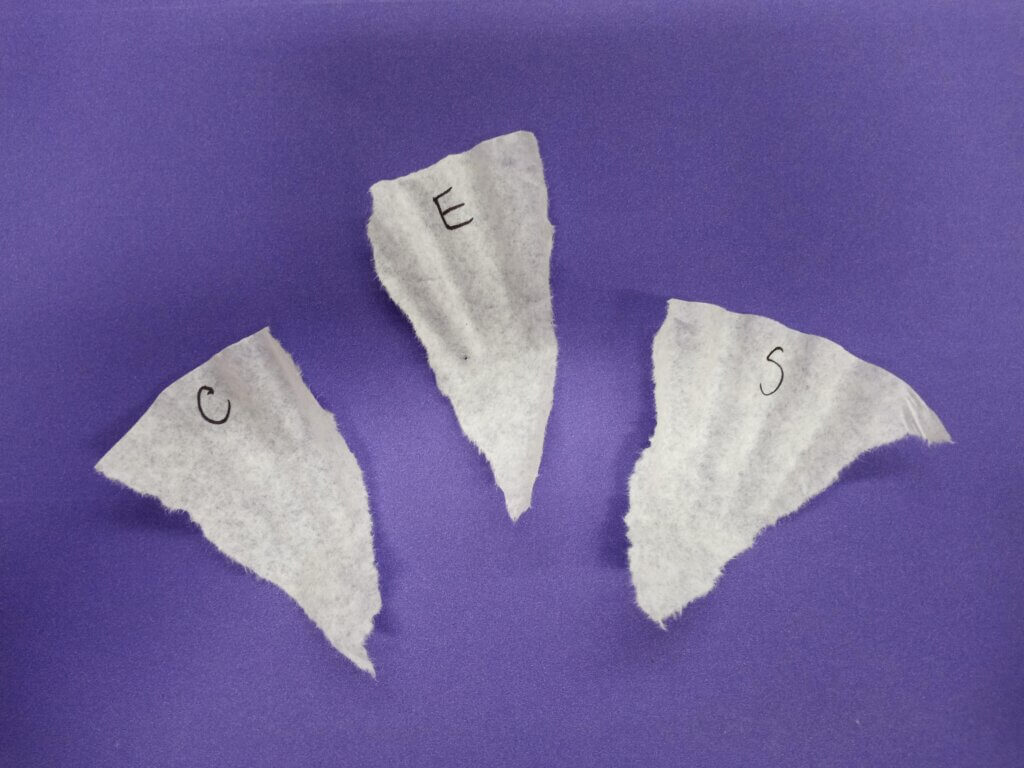
Step 3:Use the marker that matches the letter to make a thick dark mark at the bottom of each piece. 
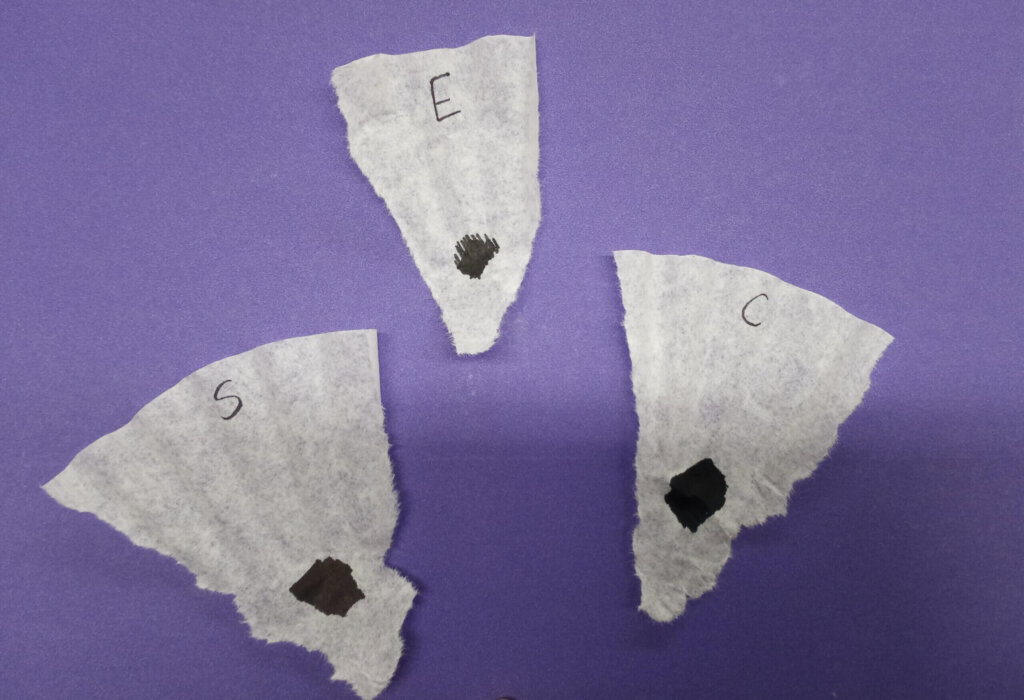
Step 4:Pour a little bit of alcohol into the bottom of the bowl. 

Step 5:Place the tips of each of the three filter pieces in the bowl so that they are touching the alcohol. It will take a little time, but you should start to see the ink move up the filters. 
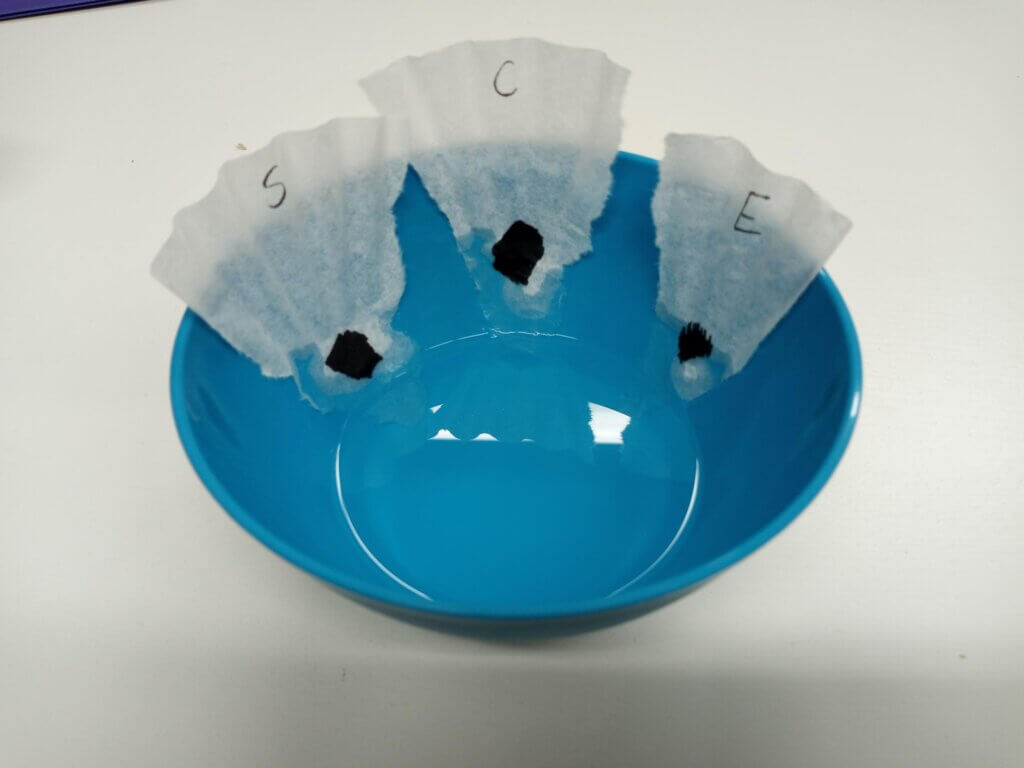
The Science of Chromatography 

  • Alcohol acts as a solvent and dissolves the chemicals that make color in markers. The chemicals that dissolve best will move further up the filter. 
  • Sharpies are alcohol based, Crayola washable markers are water based, and Expo markers are alcohol based if they’re dry erase and water based if they’re wet erase.  
  • The alcohol based markers will dissolve better in the rubbing alcohol because it is the main ingredient in the ink. 

Expand on the Activity

Did you enjoy this Chromatography experiment? Expand on the activity with the options below.

  • Ask Your Scientist the Following Questions: 
    • Did the inks travel at the same speed? 
    • Did they all travel the same distance? 
    • What other ways could chromatography be useful? 
  • Keep Experimenting: 
    • Try it with other types of black ink, like a writing or drawing pen. Would it work with printer ink? 
    • Does the color of the ink matter? See our OSC @ Home blog about capillary action to explore a colorful version of this experiment. 
    • Try using water instead of alcohol and see if it works.
Can You Hear Me Now? Learn to Make a DIY Cup Phone

Can you hear me now? Learn how to make a DIY Cup Phone!

How do phones allow us to talk to people who are so far away? We can find out by making a DIY cup phone using things you might have around the house. 

Telephones turn sound waves into electricity that can be sent using cables. Once the sound electricity reaches you, magnets are used to convert the electrical signals back into sound waves. The sound vibrates the air around it, so you can hear what the person on the other end of the line is saying. 

Ready to make your own? Follow the written steps below!

Materials you will need: 

  • 2 Styrofoam or paper cups
  • Twine or other string
  • Scissors
  • Markers (these are optional!)

Directions

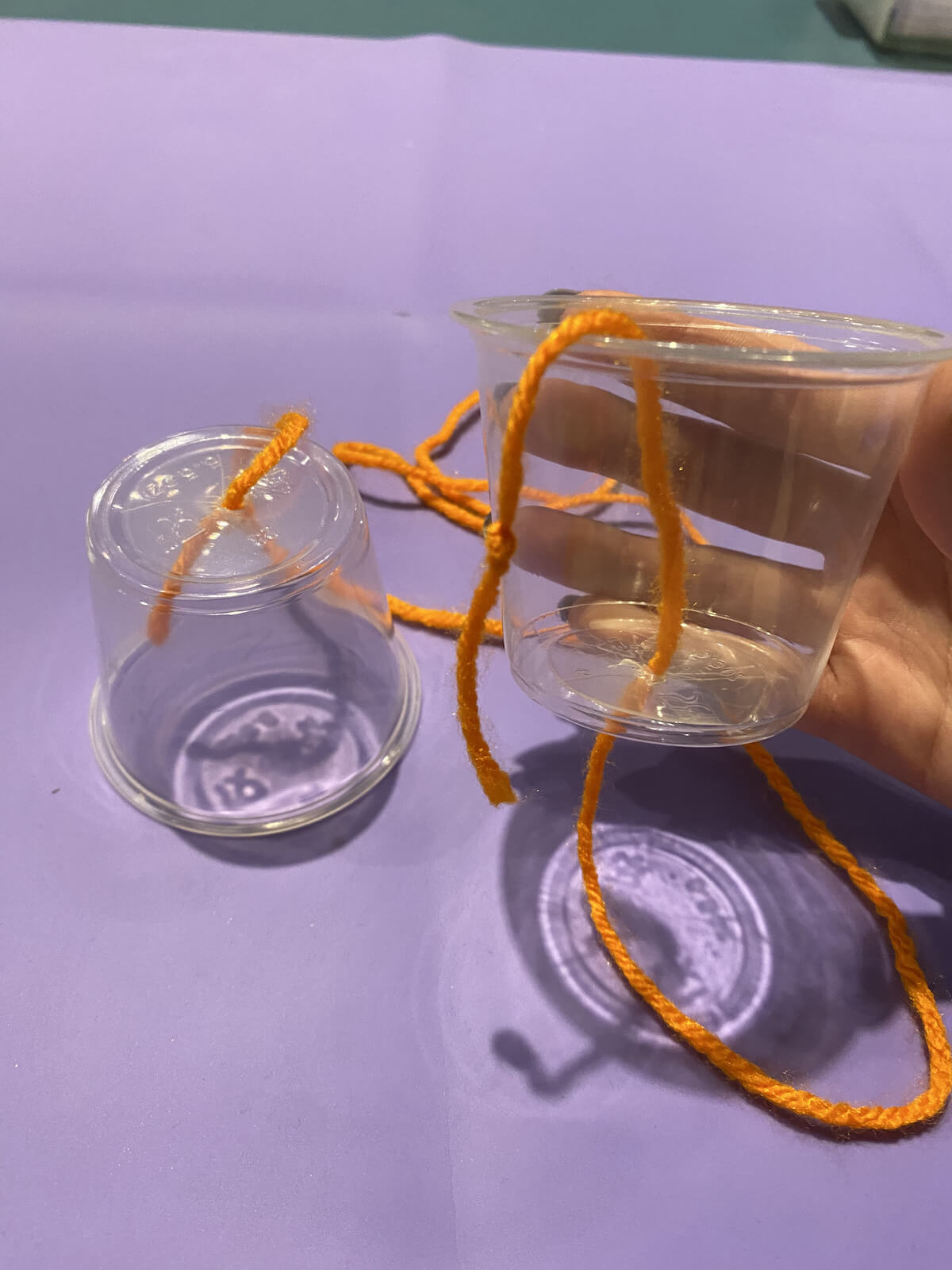
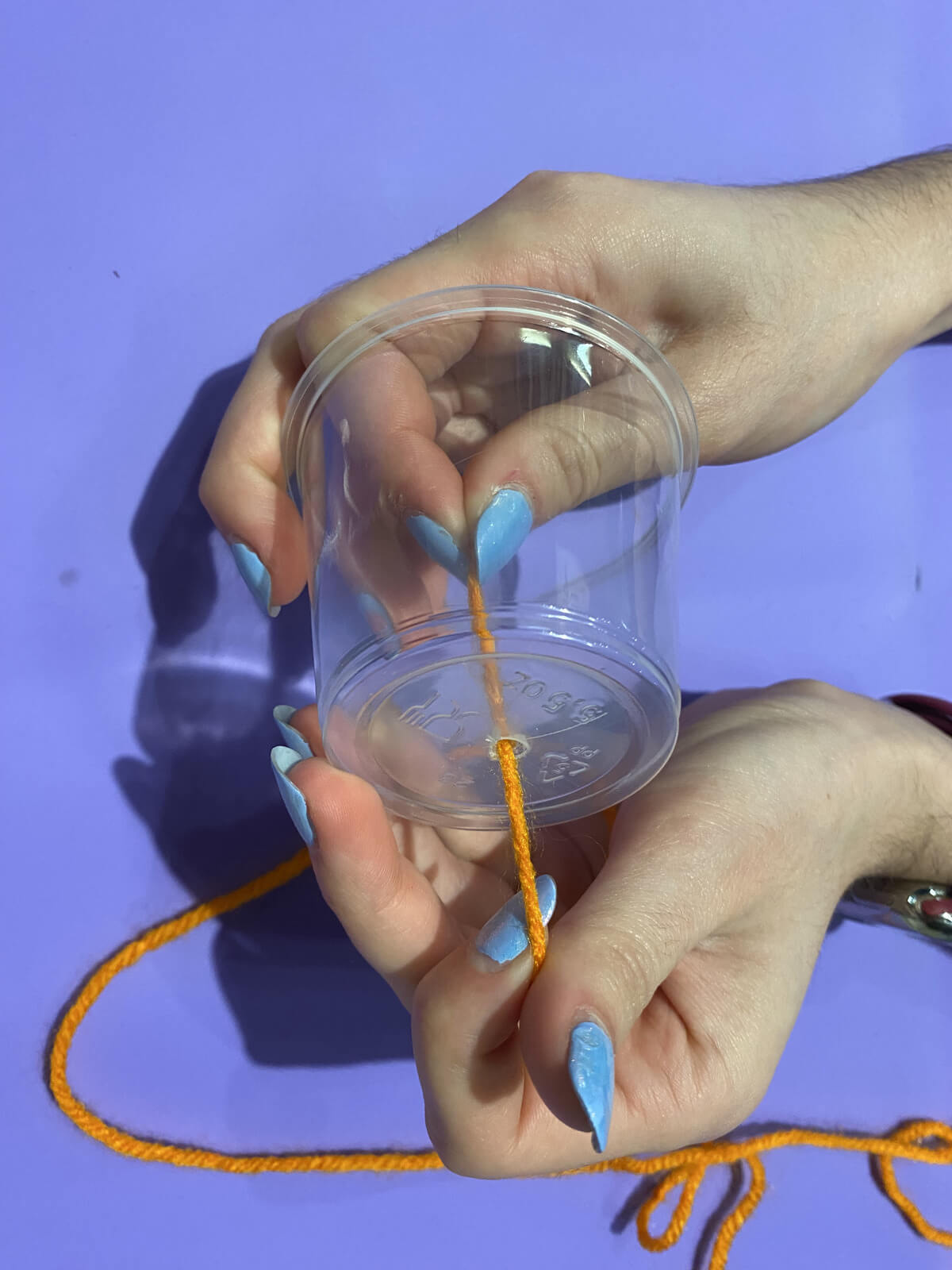
Step 1: Use the scissors to poke a hole in the bottom of each cup.

Step 2: String a piece of twine between the cups by pushing each end of the string inside the holes you just made. Use a long piece of string to help the sound travel farther.

Step 3: Tie a knot in the end of the string inside the cups to keep the cups from falling off.

Step 4: Feel free to decorate your cups with markers if you want, but there's nothing wrong with keeping them plain!

Step 5: To use the phone, all you have to do is talk into the cup while someone else holds the other cup to their ear. Make sure to keep the string tight; if the string is sagging, the sound won't travel effectively!

The Science of Cup & String Phones

  • You may have heard that sound travels - but how?
  • Sound is made up of waves that we can hear. These sound waves are formed by objects vibrating, or shaking back and forth very quickly. 
  • Sound travels through air, water, and solid objects as vibration. 
  • The sound of your voice vibrates the cup, which cases the string to vibrate, too, as sound travels down it. 
  • Our ears collect the sound vibration, where nerves send them to our brain. 
  • Our brains process the signals, and then we hear the sound!

Ask a Scientist Question Archive

About our Scientist in Residence

The Scientist in Residence is a STEM professional who is an expert in their field. They're also available to provide unique insight into trending science topics, promote science literacy, and answer questions from the public.

Dr. M.J. Soileau is currently serving as our inaugural Scientist in Residence. A big personality with a passion for improving the STEM environment, Dr. Soileau has been a trailblazer in both optical research and higher education.

He has been a fervent supporter of Orlando Science Center since the 1980s, when he first joined the Board of Directors. Now an Emeritus Member of the Board, Dr. Soileau served as Chairman during a critical period of the Science Center's history, garnering financial resources and governmental support for our mission.


Dr. Soileau Answers Your Questions!

We have received some fantastic questions from guests, campers, and preschoolers alike for our Scientist in Residence. Check out his answers below and check out the Ask a Scientist page for the most current questions! You can also submit your own questions on this page. Let's get curious together!

The short answer is that air molecules scatter the blue light from the Sun much, much more than other colors and in all directions. This makes our sky blue. Below is a more detailed explanation.

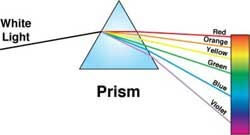
Sunlight is a mixture of all the colors of the rainbow. The colors in sunlight have almost the same intensity. Our eyes perceive this mixture as white light. CAUTION: DO NOT LOOK DIRECTLY AT THE SUN!!! Serious eye damage can occur!

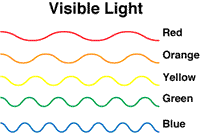
Light is a wave, and red light has a longer wavelength (distance between peaks of the wave) than blue light. The molecules of air are much, much smaller than the wavelengths of visible light. Therefore, the air scatters sunlight in all directions. The blue light in sunlight is scattered much, much more than the other colors, making the sky appear blue. This explanation is called Rayleigh scattering, named for the 19th Century British physicist who discovered it.

white light entering a prism and being divided into colored light rays  the wavelengths of visible light by color. red has the longest wavelength and blue has the shortest.

Farts are a natural byproduct of eating a nutritious diet to supply our bodies with energy and nutrients needed for us to survive and thrive.  Farts and poop are the waste products of our digestive process, which extracts the needed stuff from our food.   

Why do farts (flatulence) smell so bad? The answer starts with the food we eat.  For example, eggs (very healthy food) contain sulphur (S), which combines with oxygen to give us energy. The waste product of digesting eggs is sulphur dioxide gas - sometimes called rotten egg gas because it smells like rotten eggs…ugh!  A lot of the food we eat (raisins prunes, meat products, vegetables, soft drinks, wine and beer, etc.) contains sulphur compounds.  A waste product of digesting that food is sulphur dioxide, which our bodies expel as smelly farts!

Dogs use their tails to communicate. For example, when your dog sees you, they wag their tail to communicate to you that they are excited to see you. It's a way of showing their affection for you. 

On the other hand, when a dog does something wrong and you scold them for it, the dog might stick its tail between its hind legs and slowly wag it. This communicates to you that your dog is feeling sorry or ashamed. 

However, just as our voices can communicate anger or fear in addition to excitement and affection, sometimes a dog wagging its tale is communicating that they are angry or afraid. You can probably tell the difference with your dog, but it's more difficult to tell with a dog you don't know. Never approach or touch an unknown dog unless their owner is present and gives you permission!

In science, it's important to ask the right question to get the best answer. We can better understand the answer to this question by changing the word "heat" to "light." So, let's look at this question: Since white reflects light and black absorbs light, why are the lenses in sunglasses usually black?

The answer is that we make sunglasses partly black to absorb some fo the sunlight coming through them. That way, the light that makes it through the dark glasses is not too bright for our eyes. 

Note that sometimes sunglasses look shiny white rather than dark. These glasses are made of very thin layers of metals (like aluminum) that reflect some white light but let some through. The light that comes through the lens is now safe for our eyes, because it's not too bright. 

Explore More! Words used in science have very specific meanings. For example, light is electromagnetic radiation. That radiation can be reflected (off a mirror), transmitted (through a clear piece of glass), or absorbed (into a black surface). The light absorbed by a black surface heats (raises the temperature) the surface. Light reflected or transmitted does not heat the surface it's interacting with. 

Crayons are made by mixing melted paraffin wax with a carefully measured amount of paint pigments to produce many colors. The mixtures of pigments and paraffin wax are then poured into special molds in the desired shape and allowed to cool and become solid.

Ask a Scientist: Dr. M.J. Soileau

Introducing our Scientist in Residence

As an institution, Orlando Science Center is dedicated to increasing science literacy in our community and beyond. We're taking steps to solidify our place as a trusted resource for up-to-date information on popular science topics. From climate science to space exploration, we hope that when a community member has a STEM-related question to ask a scientist, we are the first place they go to find out more.

As part of this endeavor, we are proud to introduce our Scientist in Residence, an initiative that goes hand-in-hand with our Science Matters campaigns. The Scientist in Residence is a STEM professional who is an expert in their field. They're also available to provide unique insight into trending science topics, promote science literacy, and answer questions from the public. 

Meet Dr. M.J. Soileau

It is our pleasure to introduce Dr. M.J. Soileau, our inaugural Scientist in Residence. Dr. Soileau is the perfect person to help us launch this effort. A big personality with a passion for improving the STEM environment, Dr. Soileau has been a trailblazer in both optical research and higher education.

He has been a fervent supporter of Orlando Science Center since the 1980s, when he first joined the Board of Directors. Now an Emeritus Member of the Board, Dr. Soileau served as Chairman during a critical period of the Science Center's history, garnering financial resources and governmental support for our mission.

Dr. Soileau is a Louisiana sharecropper/laborer's son who hoed cotton to pay for college. As you can tell, he learned the value of hard work early. Dr. Soileau remembers his parents as good, hardworking people who raised him to speak bluntly and pursue goals relentlessly. 

"I never was the brightest star in the galaxy - and I'm still not - but I grew up learning how to work," Dr. Soileau said. "I think one of the most important things you learn in science is, if you really push on a problem long enough and hard enough, it gives up."

Dr. Soileau moved to Orlando in January 1987 to be the founding director of the Center for Research in Electro-Optics and Lasers (CREOL) — now CREOL the College of Optics and Photonics — at the University of Central Florida (UCF). He dedicated more than 35 years of his career to UCF, transforming the fledgling research center into one of the major educational and research institutions for optics in the world. Dr. Soileau became Vice President for Research and Commercialization in 2000. He then returned to the CREOL faculty in the Fall of 2016 and retired July 2022. 

"What a wonderful life to spend your life learning stuff," Dr. Soileau said. "And by the way, when you teach, you learn so much more than the students do."

It is this passion for learning and education that we hope will permeate our halls and help support us in our mission to inspire science learning for life. As our Scientist in Residence, Dr. Soileau will be making appearances and offering unique experiences throughout the year. This partnership promises to deliver exceptional educational value to our members, visitors, and the Central Florida community — from special presentations at Science Night Live events to guest workshops with the kids of Neighborhood Science. 

Dr. Soileau Answers Your Questions! 

We have received some fantastic questions from guests, campers, and preschoolers alike for our Scientist in Residence. Check out his answers below and stay tuned for monthly updates! If you're interested in submitting a question of your own, check out the information below. Let's get curious together!

A list of previously answered questions can be found in the Ask a Scientist Question Archive.

When we eat, our body quickly digests the food in a bath of strong stomach acids, liquifying the food so that our stomach walls can absorb the nutrients released and deliver them to the body parts that need them. If our stomach acids are not strong enough to liquify the seeds, then our body expels the seeds in our poop.

The clockwise spin of Venus matters because it is an exception, as the questioner points out. Scientists are always looking for exceptions to models that explain our physical world.

The model of how our solar system evolved starts with the gravitational collapse of interstellar clouds of gas and dust (which come from large exploding stars in the distant past). The laws of physics predict that the collapsing cloud of material will flatten into a disc, with most of the mass at the center (where the new star is born). Turbulent gas in the disc forms planets. In this model, all objects in the solar system orbit and spin in the same direction.* 

The fact that Venus spins in the opposite direction from the other planets in our system is strong evidence that during its formation, Venus was struck by and may have merged with another large body that knocked it over, resulting in the spin being opposite to its orbital direction. 

*The James Webb Space Telescope is now producing images of star formation inside giant intergalactic gas clouds! These images confirm the model mentioned above. 

Orlando Teen Invents Organic Pesticide Made From Beer

Orlando Teen Invents Non-Toxic, Cost-Effective Organic Pesticide Using Beer  Wins Top Prize at Orlando Science Center’s Dr. Nelson Ying Science Competition  

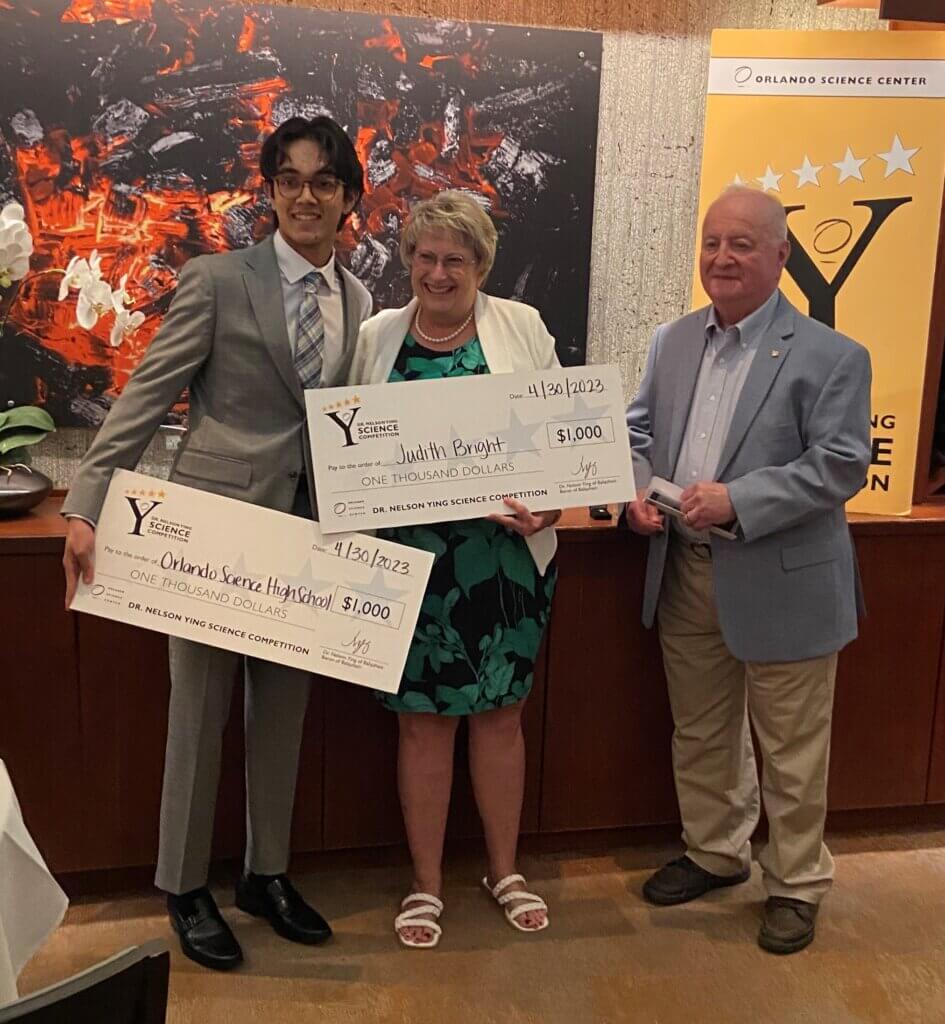
Orlando teen AtreyaManaswi, a sophomore at Orlando Science High School in Orange County, has won the top prize in the prestigious Dr. Nelson Ying Science Competition at Orlando Science Center. His research project, which used a beer blend to create a non-toxic, non-expensiveorganic alternative to chemical pesticides,won a scholarship of $5,000, a $1,000 award for hisscience teacher, and an additional $1,000 for their school.  

Atreya was named winner during an awards ceremony on April 30 after presenting his findings to the judges panel the previous day. For 25 years, Dr. Nelson Ying — local scientist, entrepreneur and philanthropist — has partnered with Orlando Science Center to celebrate outstandingstudent scientists through his creation and sponsorship of this competition.  

Atreya’swinning project ispart of his multi-year research effortto address the decline of the world’s honeybee population, which is responsible for pollinating 80% of the world’s food crops. Since 1947, honeybees have declined worldwide by 50% with two of the biggest causes being pests and chemicals. His organic solution, based on the chemical composition of beer, is just as effective as chemical pesticide, but it’s non-toxic and 80 times cheaper. Globally, it could save $1 billion dollars annually with no risk of contamination.  

To compete in the competition, each entrant must be a Florida high school student pursuing a research project that has the ultimate goal of benefiting humanity. This year, submissions were accepted from throughout the state and finalists included students from Central Florida as well as Fort Lauderdale and Tallahassee. Projects ranged from creating algorithms that identify behaviors that could lead to recidivism in paroled convicts to developing biodegradable bone implants to training honeybees to pollinate endangered plant species. In addition to the grand prize winner, each finalist received cash prizes to continue their research.  

Atreya Manaswi and Judith Bright OSC Dr.Ying Competition Winner Teacher 2023

Meet the Finalists!

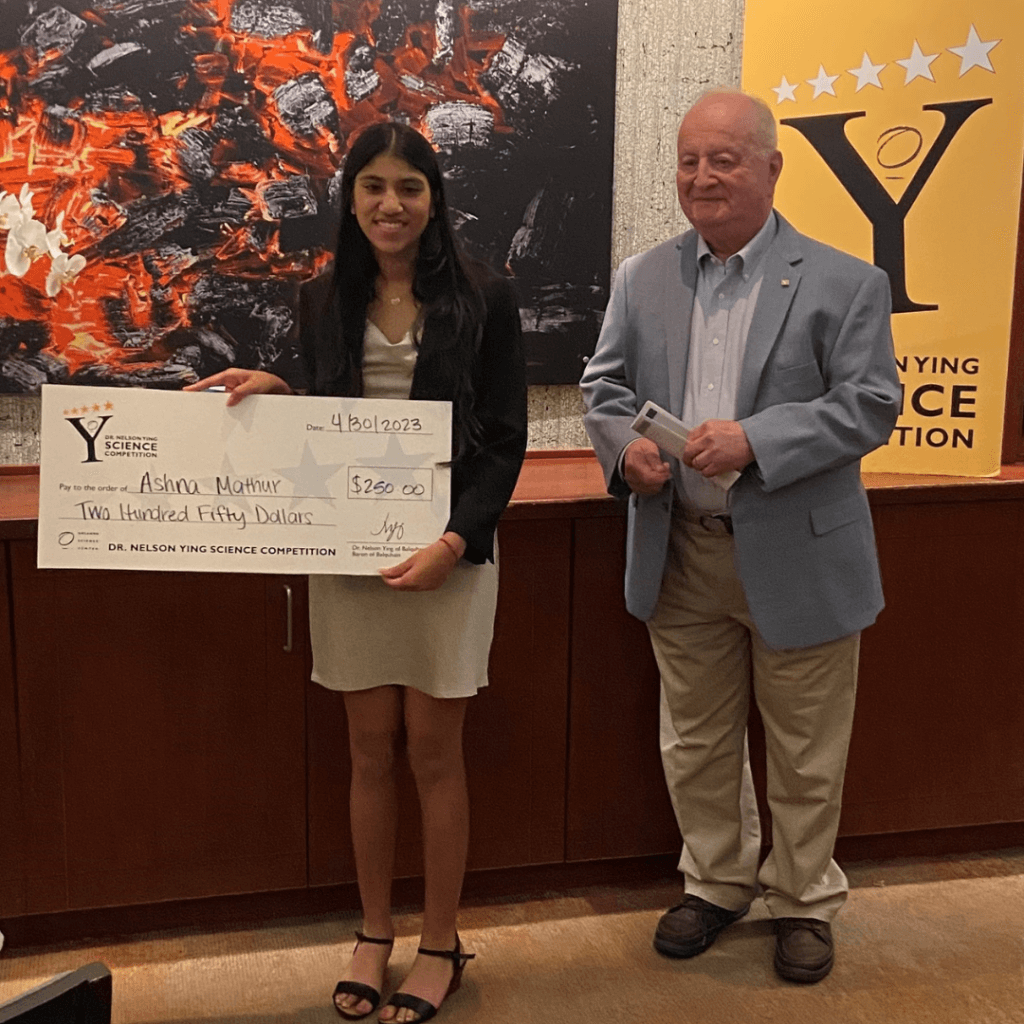
Ashna Mathur, Sophomore, Lake Highland Preparatory School, Orlando 

Currently, surgeons use inert metals for bone implants following injury, which ultimately need to be removed because they can’t be absorbed by the body. To prevent these costly and time-consuming surgeries, Ashna developed implants with Magnesium, which is biodegradable. She mixed Magnesium with Scandium, Strontium and bio glass nanoparticles to enhance its mechanical properties and promote bone growth.  

Ashna Mathur

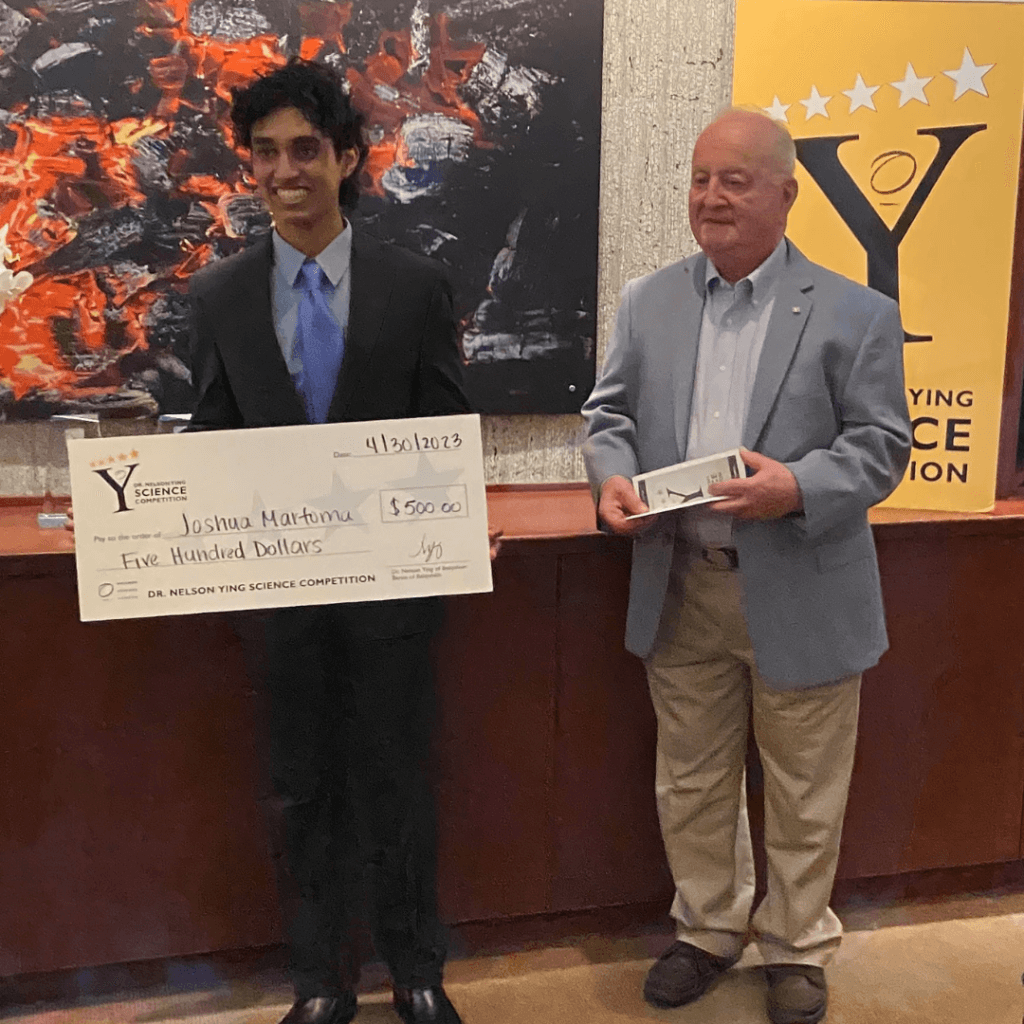
Joshua Martoma, Junior, Pine Crest School, Fort Lauderdale 

The United States has the largest incarceration rate in the world with 68% of people in prison returning to prison. Joshua created a machine learning algorithm to identify the risk factors involved with paroled convicts to predict the likelihood of them returning to prison. The goal of his research is to increase the fairness, accuracy and transparency of existing tools to help prevent recidivism amongst this population.  

Joshua Martoma

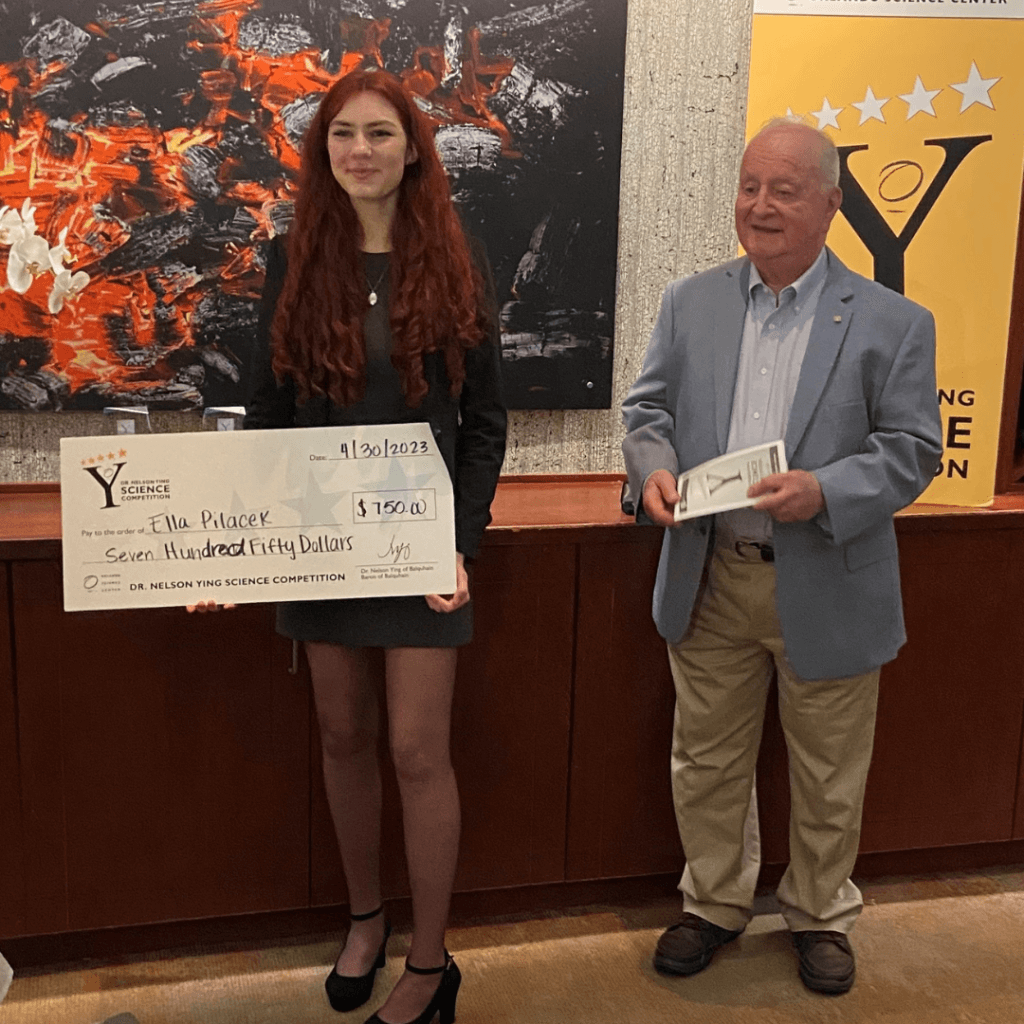
Ella Pilacek, Junior, Oviedo High School, Oviedo  

Many species of indigenous plants are endangered in Florida due to habitat fragmentation, which results in plants being separated from native pollinator species. Ella trained honeybees to pollinate endangered plant species through Pavlovian conditioning. She repeatedly fed bees a food solution while also feeding them the scent of the endangered plant. Honeybees would associate the scent with a good food source so they would pollinate endangered plants that they would have ignored otherwise.  

Ella Pilacek

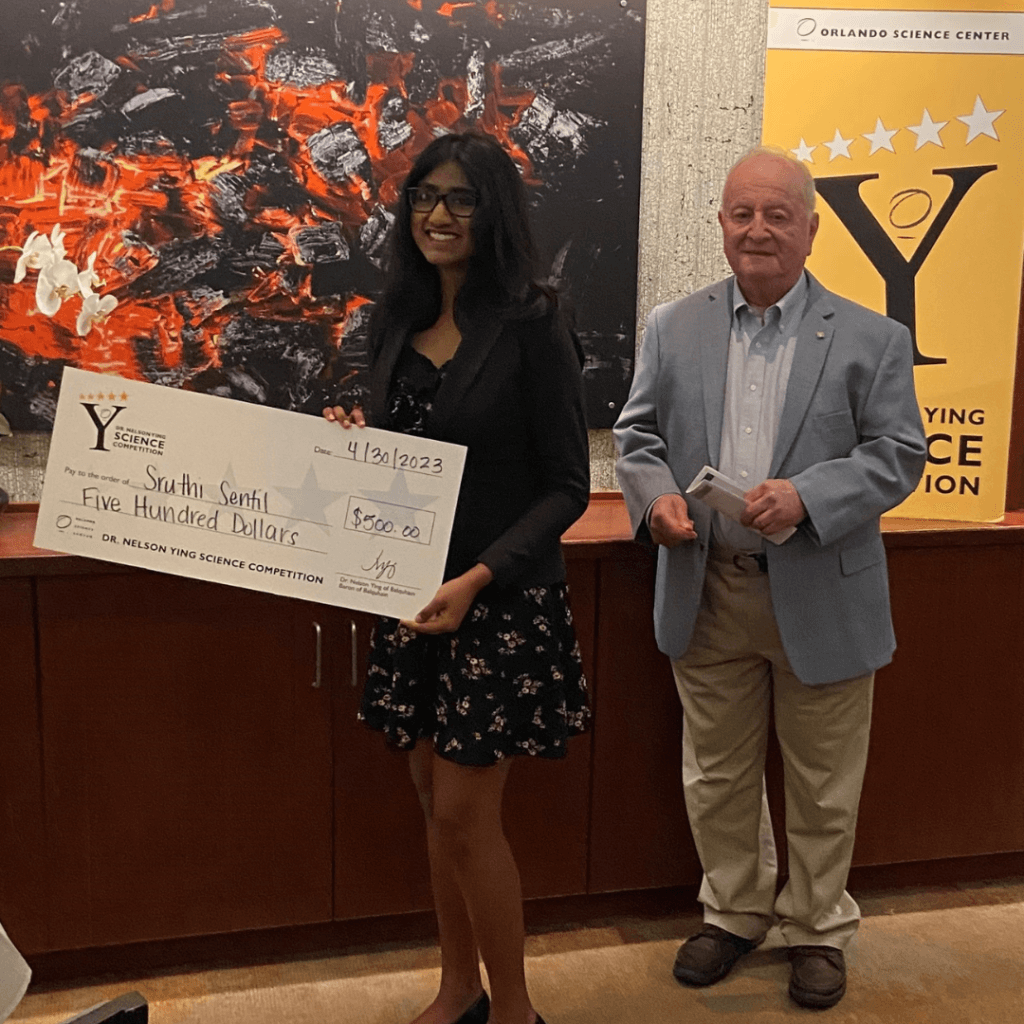
Sruthi Sentil, Senior, James S. Rickards High School, Tallahassee 

The world’s citrus population has been devastated by many invasive species of insects. Sruthi focused on the insect Citrus Psyllid and created a device to imitate its mating call. She was able to use these mating calls to lure this pest away from citrus crops and attract them to traps.  She also determined that this process could be used on other pest insects to positively impact citrus production worldwide.  

Sruthi Sentil

The Dr. Nelson Ying Science Competition has been encouraging tomorrow’s problem solvers and world changers since 1999. Scientist, inventor and entrepreneur Dr. Nelson Ying created this competition in partnership with Orlando Science Center to inspire exemplary science students to use their expertise to address real-world problems. Previous winners of this competition have gone on to continue their research at top universities, compete in national science competitions and ultimately pursue exciting STEM careers, including positions at NASA’s Jet Propulsion Laboratory.  

The Science of Pancakes

The science of Flipping Pancakes

Pancakes are a common staple at the breakfast table, whether you’re at home in your PJs or drinking coffee at a diner, and it’s not hard to see why: they’re fluffy, light yet filling, and typically covered in delicious syrup. It’s designed to be comforting cuisine! They might be simple and quick to make, but there’s a lot of chemical science at work that’s easy to miss with your standard sleepy-morning eyes, so we’re going to examine the major steps along the way, from batter consistency to the right color. Let’s dive in to the science of flipping pancakes!

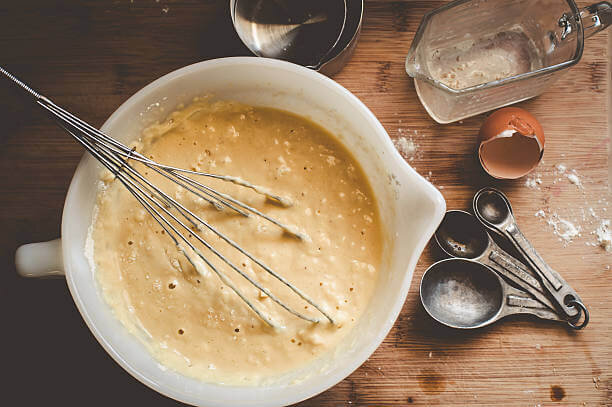
Naturally, the first step when making pancakes is to prepare your batter.

You can create it by either combining dry and wet ingredients like flour and eggs, or by using a pancake mix from your local store, which we’ll be looking at today. Pancake mix will take less time overall than measuring and combining all the other materials since they’re blended already, and contains dehydrated fats like powdered butter, egg powder, and buttermilk. Dehydrating fats, or drying as much moisture out as possible, prevents bacteria, yeast, and mold from growing and ensures the mix stays fresh for long periods. When we add a liquid like water or milk to it, it rehydrates the fats and produces the batter substance we’re looking for.

Before adding the liquid, your bowl contains plenty of dry ingredients and each one has its own role to play. The first ingredient is commonly used in the kitchen: flour. Flour is a powder ground from types of grains. One of these flours, wheat flour, contains two types of proteins that link together and make gluten. 

So what's happening? 

The natural chemical leavening agent we’ll be using is baking soda. This helps pancakes rise up while being fluffy and soft. Baking soda is a base with a high alkaline. When it mixes with an acid or in this case, the buttermilk, it creates bubbles that release a lot of gas.

If you’ve ever combined baking soda and vinegar before then you’ve seen the chemical reaction!

Pancake batter ready for pancakes

Now it’s time to add our liquid to help rehydrate the fats. Box mixes usually call for water, but today we’re going to add milk. Milk will up the fat content of our combination, leading to tender flapjacks with more richness and flavor. Now, you might be wondering what kind of milk to use. 

The liquid helps to activate the baking soda and buttermilk, creating the reaction we just covered. These bubbles will rise as you stir. As this is happening, the CO2 bubbles will be trapped by the gluten in the batter when your pancake solidifies, leading to fluffiness! Avoid mixing the ingredients too much though. This can overwork the gluten formation and leave you with tough pancakes. You’re looking for a mixture that’s still lumpy yet blended.

Now that we’ve added our milk, it’s going to rehydrate it so the fat properties can take effect!

When you mix flour with eggs and liquid, the gluten molecules get more flexible and bind to each other to form networks, or nets. These nets trap the air from the carbon dioxide gas, causing the pancake to lift and have a chewable texture.

You can think of it like a hot air balloon, with the gluten as the balloon and CO2 as the warm air. As the CO2 rises up, it expands out the gluten netting giving it lift.

Pancake Batter Bubbling

Let's get cookin'! 

Now that we have our dry and liquid ingredients together, it’s time to get started! There’s a huge variety of ways to cook these cakes, but for this post we’ll be using a nonstick griddle pan. A nonstick surface is useful so we can flip our cakes without too much adhesion, and a griddle pan evenly distributes heat across the cooking surface so the entire cake is done at the same time. To start, you’ll want to heat the pan on medium heat, but avoid settings higher than this. Too hot would burn our breakfast and too low takes longer to finish! Once the pan is hot enough after a few minutes, take a scoop of batter and pour it in!

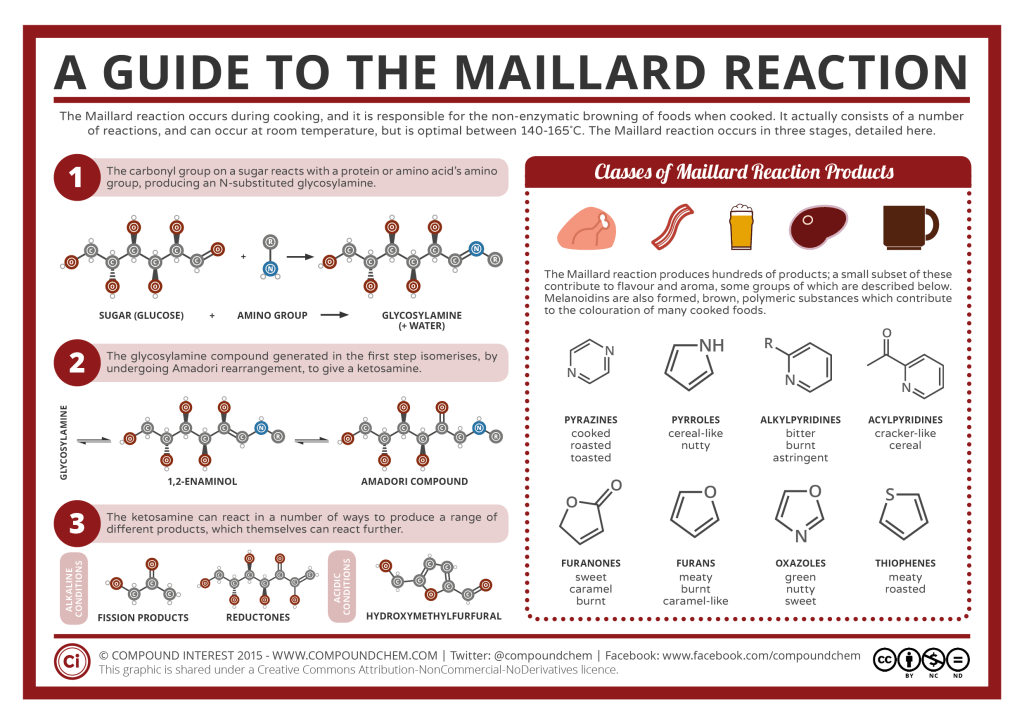
Do you see or hear anything when the mix hits the hot pan? You may hear a little bit of a sizzle. This sizzle helps indicate our next step taking place: the Maillard Reaction! This step creates the aroma and golden-brown color on the pancake.

the science of the Maillard Reaction

The Maillard Reaction is a chemical reaction between amino acids in the proteins and the carbon and oxygen atoms from sugars. They all bond together on the molecular level and result in a rich palette of distinct and varied flavors. Basically, the proteins and sugars in the mix transform into new flavors, aromas, and colors from the intense heat of the pan. This reaction is how we get coffee roasts, the crust on a steak, or the color and smell of baked bread!

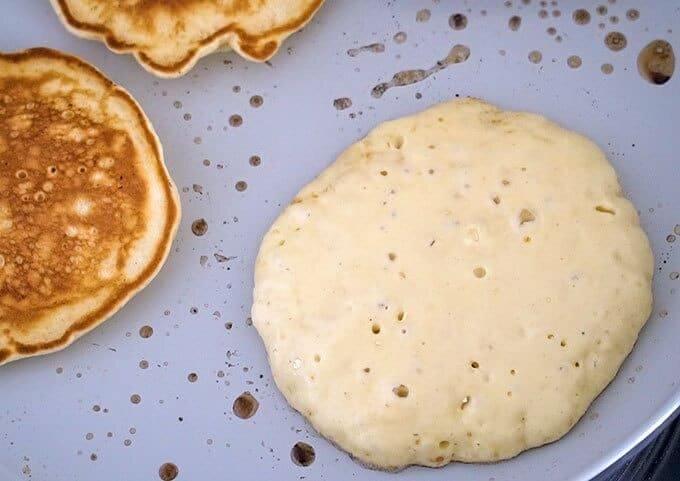
After about a minute, you’ll see the pancake start to firm up and bubbles appear on top. The pancakes turn from liquid to solid through gelatinization. This is when the molecular bonds of starch molecules start to break down when heat and water are introduced. The starch granules absorb the water, swell up, and burst, which causes the batter to thicken and form. The bubbles on top let you know when it’s time to flip the pancake to the other side. This is the gas being forced out of the pancake batter. Cooking raises the temperature and increases the pressure of dissolved carbon dioxide. Bubbles form and rise as the volume of CO2 increases and the capacity of the batter firms up. Once the bubbles pop and release gas, you’re good to flip!

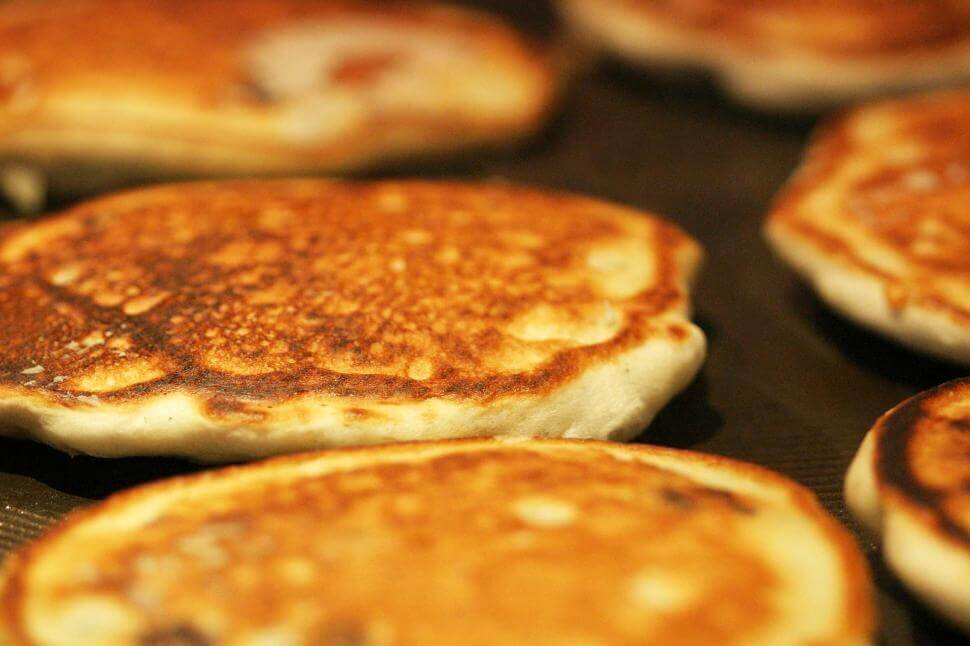
Browning Pancakes

You’ll let it cook for about a minute on the other side. It’ll take less time since there’s already heat in the pancake. Once you get the golden-brown crust you want, take it off the heat and onto your plate! Since you’ll have plenty of remaining batter, you might as well make more. Even as you get low on batter, you can still eat delicious tiny flapjacks! When it’s all ready, serve it up and add your favorite topping. Maple syrup, whipped cream, loose berries, chocolate chips…whatever your heart desires! As we can see, there’s a lot of science that can go into serving up the simple flapjack.

Protect the Planet: Our Changing World

An Eye on the Horizon

Orlando Science Center is dedicated to helping break down fears surrounding intimidating topics in order to encourage more curiosity, innovation, and discussion. We want to strengthen people’s skills in the scientific method so they can apply critical thinking skills to make informed decisions regarding science topics.

So, what is a major issue we face every day that might seem intimidating? Climate change. Building critical thinking skills and science literacy will help us better understand complex interactions and connections between us, our planet, and our ecosystems.


Questions to Consider

By the end of this page, you should be able to answer the following questions: 

What is climate change?
How does climate change affect my life?
What can I do to help make a difference? 

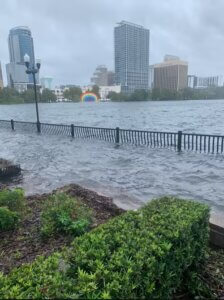
Global WarningLake Eola flooded due to rainfall from Hurricane Ian.


Take hurricanes, for example. Are they caused by climate change? No, but they are affected by it. For instance, Hurricane Ian was one of the most devastating and destructive storms Florida has ever endured. One of the top five strongest storms ever to make landfall here, Ian was the deadliest hurricane to strike us in nearly 100 years.

Many factors contributed to Hurricane Ian, so, alone, the storm can’t tell us much. But when we compare data from Ian to data from other major storms throughout history, a pattern becomes clear.

“You need to look at trends,” states Kim Prather, Distinguished Chair in Atmospheric Chemistry at University of California, San Diego. “And there is definitely an increase in the number of major weather-related disasters occurring over recent decades.”

Experts agree that while climate change cannot be credited with causing one storm, the historical changes in surface temperatures, sea level, and rainfall clearly indicate that climate change contributes directly to the strength and size of a storm.

Andrew Dessler is the director of Texas Center for Climate Studies and professor of atmospheric sciences at Texas A&M. While discussing Hurricane Ian, Dessler said, “We are 100% sure that the storm surge was more damaging because it was riding on a higher sea level. We are very confident that global warming is also causing more rainfall from hurricanes because warmer air holds more water.”

The Intergovernmental Panel on Climate Change (IPCC) provides regular assessments of the scientific basis of climate change, its impacts and future risks, and options for ways to make a positive impact. In its most recent Synthesized Report (2014), the IPCC stated clearly, “Warming of the climate system is unequivocal.”

So, what can we do? Well, that’s what we’re here to discover – together!


Why Are We Talking About This? 

The Science Matters program at Orlando Science Center is about building critical thinking skills and encouraging discussion and science literacy regarding important science topics in the news.

With this campaign, we hope to provide tools for you to help you gain a better understanding of the impact of climate change on your life. We will identify resources to help break down what climate change means and inspire us to make a positive impact. 

An Introduction to Climate Change

Our understanding of climate change has gone through several changes over the last few decades. For a while, debate centered on whether global warming existed at all. Later, the debate evolved into an either/or situation: are humans impacting the climate, or is this change entirely natural?

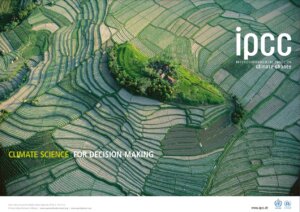
A poster from the IPCC depicting rice fields with the description: "Climate Science for Decision-Making."It is very clear that humans are changing the atmosphere through greenhouse gas emissions and deforestation, which is leading to a warmer average temperature and changes in climate and ecosystems around the globe.

The Intergovernmental Panel on Climate Change (IPCC) is a collection of people around the world who have dedicated their entire lives to the research of climate change. They’ve created detailed reports that prove these claims.

If you’d like to do your own research, you can read through these reports on the IPCC Website. The reports are a great source, and the IPCC provides more approachable summaries on their site that do a good job of breaking down the complex science.

However, if you’re looking for something more digestible, you’re in luck! There are many reliable sources across the internet. If you need help figuring out whether a source is reliable or not, check out our blog on Mythbusting Misinformation. We’ve shared some of our favorite resources on climate change below.

Understanding Our Impact

Before we dive into solving the world’s problems, it’s important to understand how our actions impact our planet. For example, a carbon footprint is a measure of how much our daily activities – such as using energy, driving a car, or disposing of waste – cause greenhouse gas emissions. This Carbon Footprint Calculator estimates your footprint in three areas: home energy, transportation, and waste. Everyone’s carbon footprint is different - try out the calculator now to see what your footprint looks like!

Plus, here are some great videos to help you understand how individuals, organizations, and countries contribute to climate change and what they’re doing now to make a positive impact.

What is Climate Change? 

From Crash Course, this video is a great introduction to the main driving forces of climate change and how individuals and organizations are contributing.

Who is Responsible for Climate Change?

From a series supported by Breakthrough Energy - a coalition formed by Bill Gates to expand clean-energy investment - this video shows how countries and politics play into climate change.

Have We Made Any Progress on Climate Change? 

From PBS Terra, explore where we've been in our race against the clock, where we're going, and how greenhouse emission projections can help us understand this story - as well as our future on this planet.

What's the Deepest Storm Surge in History? 

Hurricane Ian brought 15 feet of storm surge into Ft. Myers when it made landfall. From PBS Terra, this video explores the causes of storm surge - the most dangerous part of a hurricane - and why it matters.

Join the Planetary Defenders! An Eye on the Horizon

The good news about climate change is that it is NOT an all-or-nothing outcome. There are a million different possibilities with varying degrees of impact, and the more we do to slow down the change, the more we can minimize harm. This truly means that every little bit helps – and there are hundreds of ways to make a positive difference!

Everything from turning off lights to advocating for policy change that supports meaningful action can make an impact. One of the biggest ways you can make a difference is to simply be curious. Educate yourself and remember that there is always more to learn, no matter your background or education level.

Here are some resources to get you started in your role as a Planetary Defender:

  • Get involved with organizations and programs like Inspector Planet! On a mission to extend humanity’s time on Earth, the Inspector Planet team works to sustain the natural resources we need to survive through investigation, innovation, and information. You can help the team by reporting environmentally unusual observations, helping to collect data, or signing up for citizen/community science programs.
  • For the Grown-Ups: Many utility providers in different cities and municipalities offer rebates for making energy-saving changes around your home. For example, OUC offers a number of different rebates for both residential and commercial properties! Check with your utility provider to see if you might be eligible for any of these programs.
  • Try your hand at composting! Composting is the process of turning kitchen and yard waste into usable, nutrient-rich soil through natural decomposition. The Science Center composts food waste from our café, and it's much more approachable than you may think. Single family residents in the City of Orlando can request a free backyard composter, and our friends at O-Town Compost have community composting down to a science. Check them out and learn from the best!

How to Talk to Your Kids About Climate Change

Caregivers, you know your child best. That’s why you’re in the best position to talk to your kids about climate change! Each of these articles offers suggestions and perspectives for preparing for and facilitating successful and supportive conversations about climate change with kids of all ages – from young children to teens. While these are arranged by most appropriate age from youngest to oldest, each of these resources has something to be learned for all ages.

Did your child have questions about climate change following your conversation? Are they feeling a strong need to help and take action? These resources provide specific tips for children and families to conserve resources and reduce their impact. They’d be a great follow-up resource to conversations about protecting the planet.

Be sure to check in at the KidsTown Studio for a copy of our Science Matters/Climate Change Children’s Book List. The list will also be available on the OSC app! These books offer age-appropriate introductions (covering ages 3-12) to what’s happening and how children and families can help!

Walking the Walk at Orlando Science Center

At Orlando Science Center, it’s important to us that we pair online resources like this with on-site activities that help reinforce these concepts. That’s why we have a couple of activities planned – both scheduled shows and pop-up activities – that can help you get hands-on with climate change as a concept!

Every day at 4:00 pm, we run a live show on the Discovery Stage in Our Planet to help visitors understand the basics of climate change. The show includes simple demonstrations to help you better understand climate change, as well as a few hands-on activities to show just how difficult it can be to agree on how to tackle complex issues like this. You’ll learn more about the concept of carbon neutrality and explore the simple science around how our planet is warming.

Plus, we’ll be debuting a large pop-up activity in the rotunda, where guests will be challenged to demonstrate the carbon cycle with just buckets and ping pong balls! Explore how carbon levels balance (or unbalance!) as visitors redistribute themselves around the board, serving as symbols of volcanoes and trees, which emit and absorb carbon, respectively.

We’ve also created a number of programs in KidsTown specifically for our visitors aged 7 and below. These resources include a special KidsTown Studio bookshelf, guest StoryTime readers like local meteorologists, and family-friendly resource sheets with tips on talking about and addressing climate change together, we have programming for all ages!

In addition to our hands-on approach to learning, we also believe in doing our part to combat climate change. Have you ever wondered what happens to the aeroponic plants we grow outside the 4Roots Café? They become food for some of our animal ambassadors! We also use old shredded documents to provide enrichment and comfort in their enclosures.  These are just a few ways we are working to do our part and make a positive impact. 

Hope for Tomorrow

Like we said earlier, climate change is not an all-or-nothing issue. There is work to be done, and we can ALL help! Science begins with good communication, so help us spread the word. Talk to people in your life who might not be thinking about this! Here’s a list of conversation starters, in case you’re not sure where to begin. You can also check out this video, The Secret to Talking about Climate Change, presented by Action for the Climate Emergency.

Conversation Starters: 

  • Does our neighborhood recycle?
  • What are the most impactful things we do to protect the environment? What are the most harmful and what can we do about that?
  • Have you ever noticed changes in your local environment? How do these changes affect the plants and animals that live there?
  • What are common sources of air pollution that you see every day? What can you do to help reduce air pollution? Can you carpool, walk, or bike more instead of driving?
  • What are the things that you do that use the most water? How can you reduce the amount of water you use? Can you fix leaks and take shorter showers?
  • How can you get involved in environmental initiatives in your community? Can you join a conservation group or participate in a local cleanup effort?
  • Do you know how your food gets from the farm to your table? Can you think of ways to reduce the distance it travels?
  • How can you reduce the amount of waste you produce? Can you recycle or compost more?
  • What is your favorite outdoor place? Why do you like it? How can you help protect it?
  • What do you do every day to conserve resources? Can you think of new ways to save energy and water?
  • What are some of your favorite products, and how are they made? Can you think of alternatives that are better for the environment?
  • What are some of the dangers facing wildlife and their habitats? Can you think of ways to help protect them?
  • How much food waste is created in your house every week? What can you do to reduce that number?

We WILL fix climate change! If you’re feeling overwhelmed by all of this doom-and-gloom, don’t worry – you’re not alone. But humanity is not doomed. There is hope for tomorrow! All you have to do is take things one step at a time. In the meantime, check out these 22 inventions that show how science and innovation are helping to make a real difference in climate-related efforts around the world. 

Homemade Gifts Inspired by Science

Add a genius personal touch by giving homemade gifts inspired by science! 

We all know that one person who is impossible to shop for. Ditch the plastic packaging, and try adding a personal touch to your gift-giving by trying one of these homemade gifts inspired by science! 

Not only will you be creating a one-of-a-kind project, but you'll learn a little and have a lot of fun in the process! 


You don't need to be Michelangelo to create these homemade works of art

Try an ancient art technique 

In this DIY Fresco art activity, we will be doing a modified version that kids of all ages can do at home!


Homemade cards created with chemistry!

Creative cards

Using supplies you can find around the house, customize homemade greeting cards with this marbleized shaving cream technique. Just add calligraphy! 

Nailed it!

Here's a novel idea, add a stunning iridescent effect to any card, or create a custom bookmark. All you need is a few drops of clear nail polish! 

That's a Warp!

It’s a common misconception that wrapping paper can be recycled simply because it’s paper. However, coated, glittery, and textured paper materials cannot.

When these unrecyclable materials get mixed in with recyclable products, it can result in the whole lot being thrown away. Instead, try using paper materials like newspapers, old maps, comics, or make and design your own using recyclable paper bags and DIY stamps!


Reduce, reuse, UPcycle! 

Stitch outside the box

Give your clothes a second life by adding accents or embellishments. Get inspired with some of these embroidery ideas! 

Copy & Paint

Looking for an easy way to customize a t-shirt, tote bag, or even a pair of jeans? With this puffy paint technique, you have a chance to refine your design and keep yourself from suffering the agony of using puffy paint with a shaky hand.

DIY Tie-Dye 

Turn your avocado skins into a fashion statement! Learn how to extract tannin from the pit and skin of avocados to make your own fabric dye!  

Creep in to Spooky Science Month at Orlando Science Center

BOO! Kick-off Spooky Season with haunted STEM science fun! 

It's SpOoOoOky Science Month at Orlando Science Center! From phantom physics to Oogie Boogie Oobleck, creep in all month long for spooky STEM activities. Learn about the science of slime in Dr. Dare's Lab, join us for a not-so-scary StoryTime in KidsTown, or help the Ghostflusters capture mischievous spirits in the live show!

Check out some of our workshops, films, and activities available:

  • Learn how to craft a custom costume in The Hive: A Makerspace 
  • Creep into KidsTown for Spooky StoryTime and Monster Mansions Tinker Time.
  • Take your seat in one of our larger-than-life theaters for a Pumpkins and Protons Laser Light Show or Ghostflustters lives stage show
  • Step into the role of racecar driver in new Fall exhibit, Hot Wheels™: Race to Win™ Presented by Nemours Children's Health
  • And so much more!

Turn you home into a haunted house, with spooky OSC at Home activities! 

Unique Reptiles at Orlando Science Center

You can meet these magically unique reptiles at Orlando Science Center! 

The fantastic beasts: prehensile-tailed skinks. Where to find them: Orlando Science Center

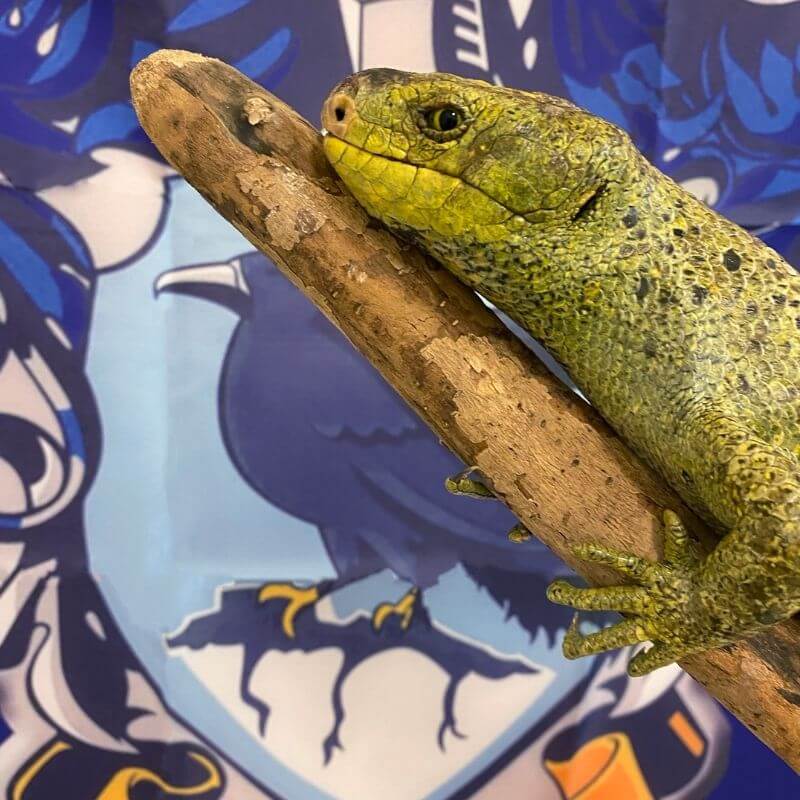
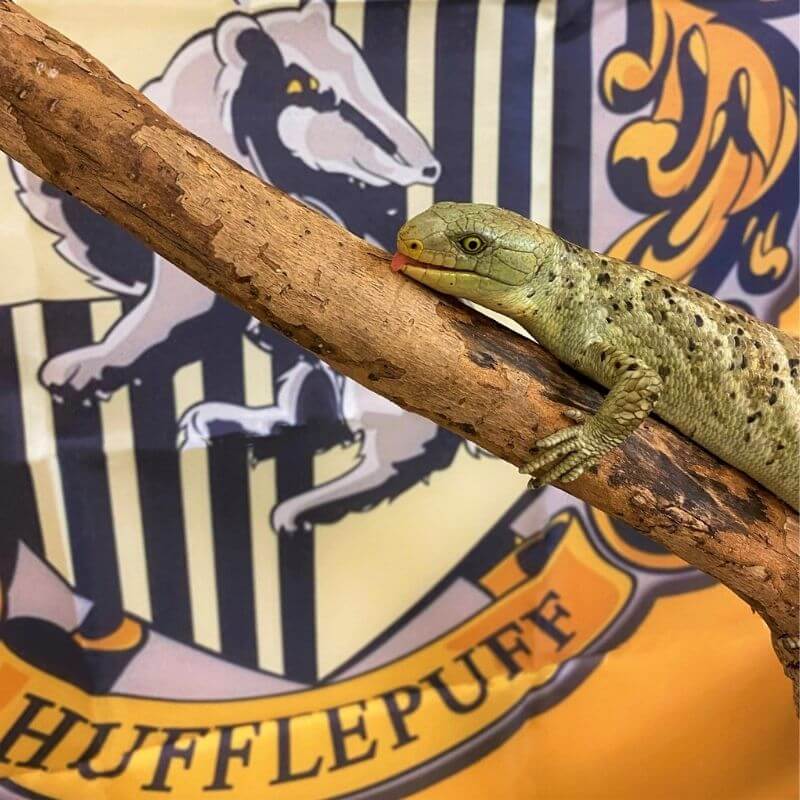
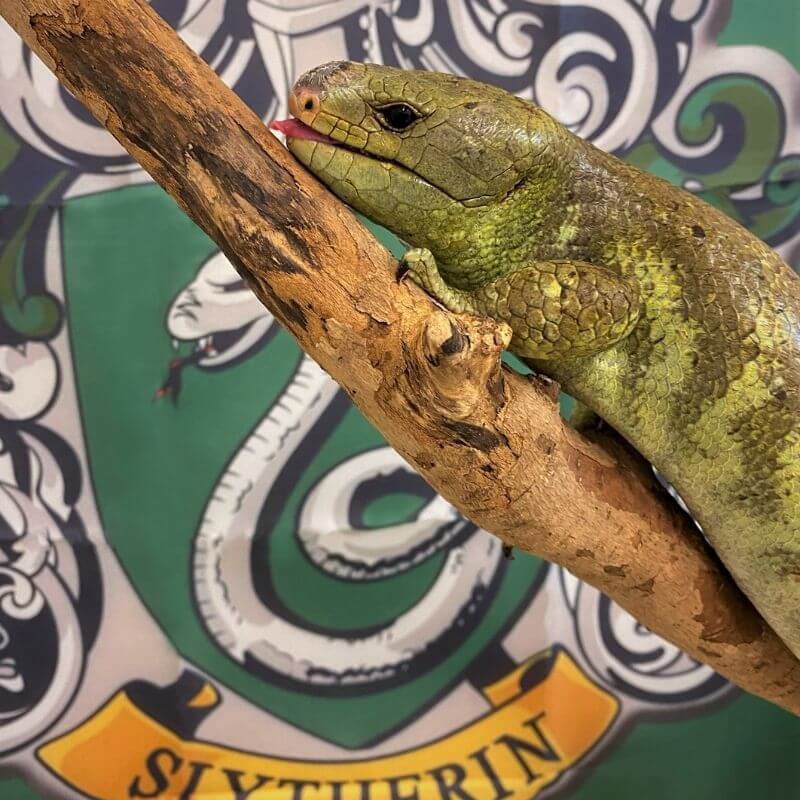
Say hello to our new and unique reptiles at Orlando Science Center — Gryffin, Sly, Raven, and Puff, four prehensile-tailed skinks who have found a new forever home.  


They don’t have their own broomsticks yet, so they flew to us via airplane all the way from California. They were confiscated by the United States Fish and Wildlife Service in a wildlife trafficking incident. Their bewitching good looks make this species a popular target for the pet trade. Gryffin, Raven, and Sly were collected in the Solomon Islands (located north of Australia) and illegally brought into the United States before being found by wildlife authorities.  

Following their rescue, Raven gave birth to Puff!

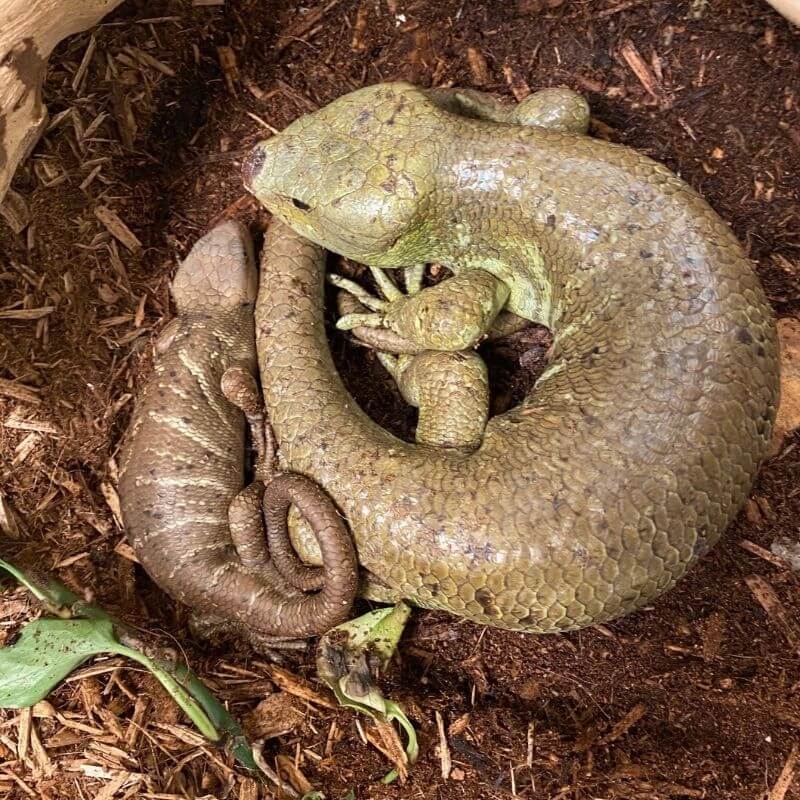
These reptiles lay their eggs inside their body and the young hatch within the parent’s body. A group of skinks is called a circulus and all of the adults in the circulus help to raise the baby. Puff seems to prefer spending most of their time with Sly, the other adult female. We are especially excited to watch Puff grow into an adult skink! 

When the skinks were first rescued, they were underweight and fighting off a parasite infection. They have been under the care of our animal experts, and we are happy to report that our veterinarian now deems them to be in excellent health! We are honored to provide a forever home and quality care to these big lizards with a big story!  

two unique reptile skinks cuddling
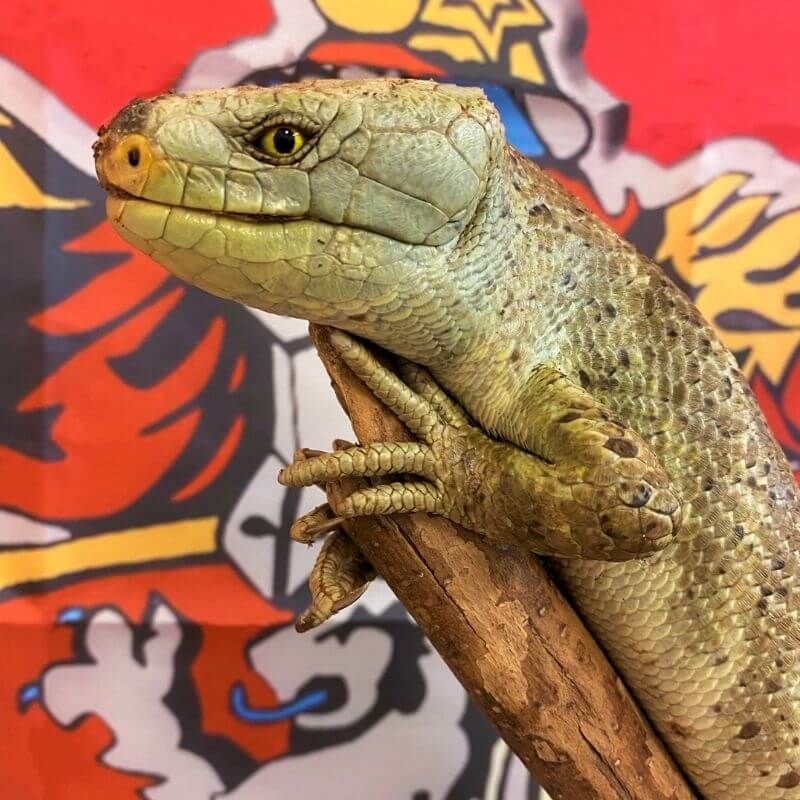
a skink on a stick with a gryffindor flag in the background
a momma skink on a stick with a ravenclaw flag in the background
a baby skink on a stick with a hufflepuff flag in the background
a skink on a stick with a slytherin flag in the background