
Make Your Own Twenty-Sided Origami Dice
We often think of dice as a modern invention, but would it surprise you to know that humans have been using dice for thousands of years? We use them now for fun and games, but throughout history, dice have been used for a wide range of purposes, including divination, developing mathematical theories, and, yes, Dungeons & Dragons.
While we celebrate Fantasy Month at Orlando Science Center, enjoy the challenge of folding your own twenty-sided origami dice! Check below to learn more all about dice throughout history, and then try a fun dice experiment that you can do at home!
Evaluate This Hypothesis:
If two six-sided dice are rolled a large number of times, then all outcomes will occur equally often.
Materials:
- 2 Six-Sided Dice
- Pen/Pencil and Paper
Experiment:
Roll 2 six-sided dice. After each roll, record the sum of the dice. Repeat at least 100 times. The more times the dice are rolled, the more accurate the results will be.
To visualize your data in real-time, plot each sum using a Dot Plot graph.
Once all rolls have been recorded use the following formula to calculate the probability of each possible outcome (2-12) based on the data collected:
Percent Chance of Outcome = (# of occurrences ÷ # of total rolls) × 100
Conclusion (Expand For Experiment Results)
Was the hypothesis correct? Is each sum of the dice equally likely?
ANSWER
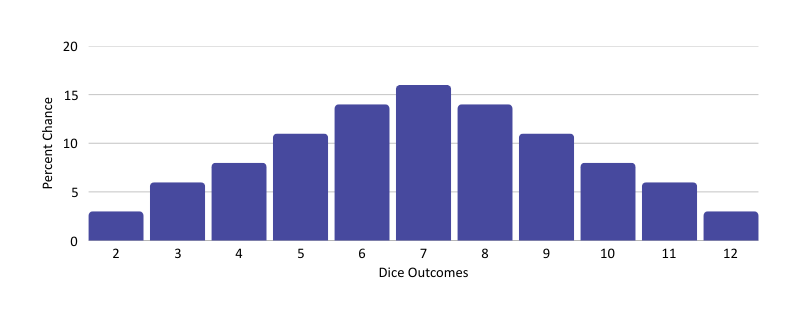
After enough throws of the dice, a pattern should emerge that shows the following probabilities for each possible outcome:
02 - 2.8% | 03 - 5.6% | 04 - 8.3% | 05 - 11.1% | 06 - 13.9% | 07 - 16.7% | 08 - 13.9% | 09 - 11.1% | 10 - 8.3% | 11 - 5.6% | 12 - 2.8%
EXPLANATION
For each possible sum of the two thrown dice, there are a set number of ways to reach that outcome. For example, a sum of 2 can only be achieved by rolling a 1 on both dice, but a sum of 7 can be achieved with 6 different combinations (1+6, 3+4, 2+5, 6+1, 4+3, and 5+2).
CONTINUE THIS EXPERIMENT ON YOUR OWN
How many combinations are there to sum the other outcomes? Does this apply for other combinations of dice? How does the number of dice involved affect the results?