Did you know purple martins travel over 5,000 miles a year? They’re the largest swallows in North America and they spend most of the fall and winter in Brazil. When spring comes along, they make the journey all the way to the states where they nestle in their cozy homes built by us!
Yes, you read that right, purple martins don’t build their own nests. They actually depend entirely on human-made nests to raise their chicks. And they have been for a long time. Purple martins have adapted to humans providing birdhouses for them, so they can’t create their own.
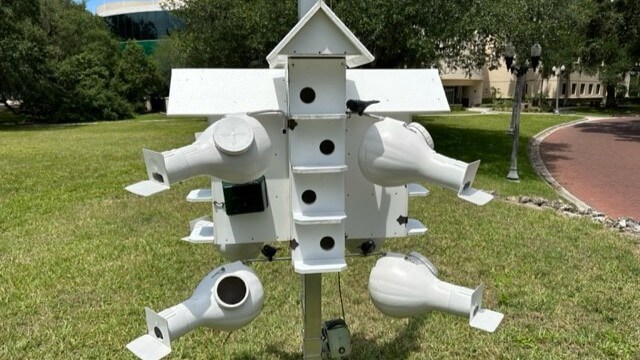
Disney’s Animals, Science and Environment department has built a specialized purple martin house for us at the Science Center, which is located just outside the 4Roots cafe in Loch Haven Park.
At OSC, we monitor 22 nesting cavities and use two types of housing: a wood house and aluminum gourds. Active nest monitoring is critical and our team checks every cavity multiple times a week from March to June. It’s possible for other birds to take over the nests meant for purple martins, which is why it’s important to actively monitor them.
Members of our Life team also lower our purple martin house several days a week to make sure it’s ready for our guests! They observe every nest, record what they see and send their observations to scientists who are working hard to preserve purple martin populations.
Last year it was confirmed that one fledgling, a chick that successfully left the nest, came from one of our aluminum gourds! The first eggs appeared in mid-April, a chick hatched in May and the fledgling was documented by early June. This was a great milestone for the colony! As the 2026 season is still in its early stages, we’re still waiting for our purple martin friends to visit.
Florida has lost nearly 50% of its purple martin population in the last 20 years due to loss of habitat and decreased insect populations. But the good news is that we can all help provide a safe space for them in our very own yards! By adding native plants to your yard, patio, school, or business, you can provide a much-needed rest stop for martins on their 5,000 mile journey. The martins will also appreciate the buffet of native insects living in your garden! Enter your ZIP code HERE to find local nurseries and websites where you can get native plants for your home or community garden.
As for the incredible researchers and scientists, they use a conservation tool called bird banding to track purple martins across seasons and their migration routes. This is just one way they know that purple martins return to the same nesting sites year after year.
To learn more about our house and help us create the perfect home for baby birds, visit the Life exhibit and join us for a Purple Martin Tour or read more about purple martins!
This project was made possible with support from Disney Conservation.