Which came first, science or technology?
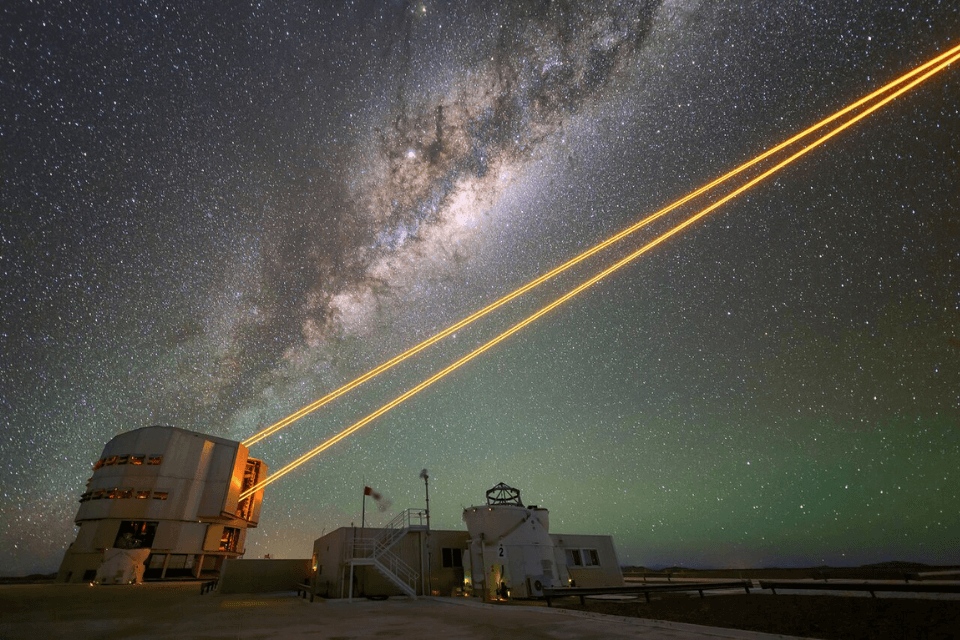
In truth, they are symbiotic processes, each disciple feeding from and expounding upon the other. Science and technology have co-evolved, and one of the best examples of this was the invention of the laser.
In 1917, Einstein published a fundamental science paper detailing how the absorption and emission of light occurs. He also introduced a new concept called stimulated emission. This would be key to the development of lasers later on. The word laser is an acronym for Light Amplification by Stimulated Emission of Radiation. (One photon becomes two, the two become four, etc. with a resulting beam that would be very directional and of a single wavelength or frequency.)
Einstein’s scientific publication was ahead of the time. It was not until1954 that the MASER (M is for microwave) would be successfully demonstrated by Charles Townes, who also coined the acronym. Townes’ breakthrough was to inject a controlled stream of ammonia gas (CH3) in an excited state into a metal box. Critical to this success was new technology that he and others developed during WWII in radar research. At about the same time, a similar approach by Basov and Prokhorov in the USSR would also be successful. Basov, Prokhorov, and Townes shared the Nobel Prize in Physics in 1964 for the invention and applications of MASERs.
The big technological breakthrough was the ruby laser, developed by Ted Meiman at Hughes Research Labs in 1962. Meiman’s laser was much less complicated than masers (the excitation source was a simple photographer’s strobe) and it produced amplified visible light, thus causing Townes to change the acronym to from maser to laser (l for light) - something we’re all familiar with today.
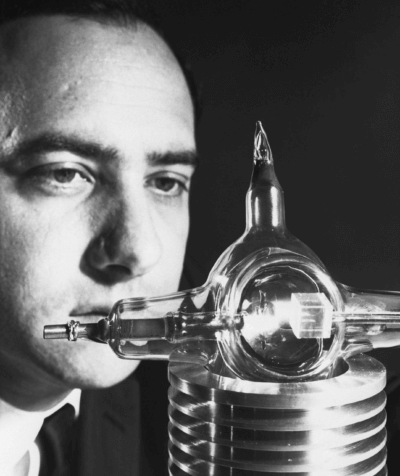
At the press conference announcing the laser, a reporter asked, “What is it good for?” After a pause Meiman said, “It is a solution looking for a problem.” The dam broke as this burst of highly intense light stimulated an explosion of new technology and new lasers! New laser materials, new materials for mirrors, lenses, and windows were developed.
In 2013, a report of the National Academy of Science documented that lasers and photonics enabled 15% of the world’s GDP. Hyperbole? Not! Lasers provide almost all of the world’s telecommunications via fiber optics.
Lasers are the basis for lithography, which in turn makes microchips for computers, cell phones, cars, appliances, etc. Lasers are the basis of new medical diagnostic instruments and treatments, and various manufacturing processes (precision laser machines produce more than a dozen components of iPhones.) The list of applications is exponentially increasing.
The feedback of new technology and innovations have resulted in over a dozen laser-enabled Nobel Prizes. That new science is producing new technologies and innovations and human progress accelerates.
On Dec. 5, 2022, the Laurence Livermore National Labs demonstrated controlled nuclear fusion ignition with the world’s most powerful laser (500 trillion watts of peak power), which in turn promises new energy sources for our future.
As the continued development of laser technology demonstrates, technology puts science to work and in turn inspires new scientific pursuits. Put another way: one hand washes the other, and both benefit!