






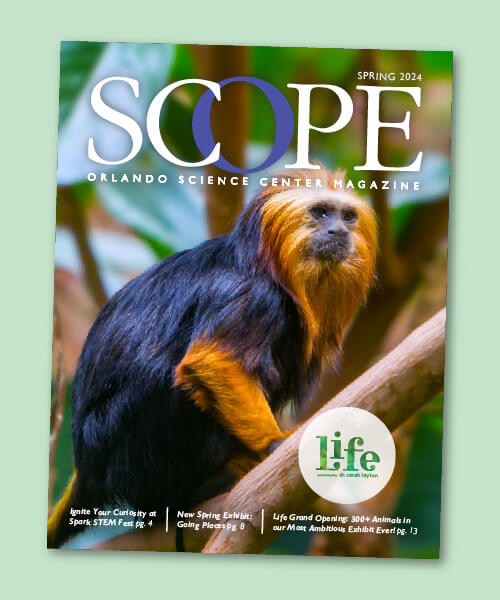
Orlando Science Center's exhibit halls feature a vast array of exciting interactive experiences! Learning has never been so fun with these hands on educational exhibits. From down to earth explorations in natural science to the high-tech world of simulation technology, everywhere you look, you'll find educational and entertaining opportunities to explore, experiment, and discover.


Traveling Exhibits

The Orlando Science Center is home to some of the most exciting traveling exhibits in the country. Upcoming traveling exhibits at the Science Center include Blue Man Group – Making Waves and Adventures With Clifford: The Big Red Dog. When these exhibits are in town they are only here for a limited time; so don’t miss the opportunity to see them!


Exhibit Halls

As great as our traveling exhibits are, there are some exhibits that are the staple of the Orlando Science Center. NatureWorks will have you up close and personal with some of nature’s most fascinating reptiles. At DinoDigs, you’ll step back into the prehistoric age. Discover the dynamic forces and systems that shape our Earth, as well as other planets in Our Planet, Our Universe. Explore such concepts as electricity and magnetism, lasers, soundwaves, and nature’s forces in Science Park. No visit to the Science Center is complete without a trip to KidsTown, an interactive world dedicated to our smaller explorers.


Science Live! Programs

What’s the difference between a great visit to a Science Center and a memorable visit? Live programs. Our exhibits are designed to inspire curiosity and exploration, our Science Live! programs are designed to bring the exhibits to life. Whether it’s a show in the Digital Adventure Theater or a one-to-one interaction with a volunteer at the Crosby Observatory, our live programs create the kind of impact that can last a lifetime.


Science Stations

Looking for little more “hard science” in your next Science Center visit? Look no further than the Science Stations located throughout the facility. Science Stations are a cross between exhibits and live programs in that they’re exhibits that typically include a live program to truly bring the experience to life. Science Stations provide an in-depth look at their respective subject matter in an entertaining way. Be sure to check your program schedule to see which Science Stations are conducting demonstrations on the day of your next visit.


Crosby Observatory

The aluminum-domed Crosby Observatory atop Orlando Science Center houses Florida's largest publicly accessible refractor telescope. This one-of-a-kind custom-built telescope, along with several smaller scopes, are available at selected times for solar and night sky viewing.


Many of you may have heard about the impending “Supermoon” doomed to destroy the whole of Earth on March 19. I’m here to ease your worry. A “Supermoon”, according to astrologers (not scientists), is when a full moon occurs along with lunar perigee, or when the moon is at  its closest distance to Earth in a year. This year’s perigee is special, because it is the closest in the past 18 years. Therefore astrologers are dubbing this particular event an “Extreme Supermoon” because of such a rare occurrence.

What does this mean for Earth? Not much actually. Some will have you believe that having the moon so much closer to Earth will provide catastrophic earthquakes, volcanic eruptions and overwhelming tides. Science, however, tells a different story. While the tides will be slightly more affected than usual the gravitational influence of the moon on the Earth’s crust, mantel or core will be negligible.

If you are interested in viewing the moon, 10% larger than normal, we do not recommend you use a telescope because your own two eyes will provide you with the best observing. The moon's surface will be too bright through the telescope to notice features like mountains or craters. Our Crosby Observatory will not be open this weekend, but we encourage you to check the website for our next public availability. Until then, enjoy the view, don’t fear it!

If you have questions, please feel free to contact us at our Astronomy Information line, 407.514.2051, or  email us at This e-mail address is being protected from spambots. You need JavaScript enabled to view it .

full-moon-biggest-2011-supermoon_33352_600x450


Bookmark and Share

Dinosaur enthusiasts unite for the exciting return of the Orlando Science Centers Fifth Annual Fossil Fest this Saturday, March 19 - 11 am to 4 pm.

This Scienterrific Saturday event is a celebration of dinosaurs, paleontology and everything that's fantastic about fossils! Join the Florida Fossil Hunters as they share specimens unearthed on local expeditions.

See huge bones and teeth from the Mega Beasts that thrived here during the Ice Ages or learn about methods used to find and preserve these prehistoric wonders. Marvel along side the Central Florida Shell Club as they display shells and corals from when Florida was just a reef. The Dr. Phillips CineDome will submerge guests into prehistoric screenings of the giant screen spectacular - Sea Monsters.

Activities include dino-crafts like design your own triceratops hats, plus battle against extinction with emamosaur racing, take a leap into the Jurassic period with fossil making and create your very own unique dinosaur replication model! Hands-on geology and paleontology experiments will be taking place in Dr. Dares Lab.

Admission to the event is included with a general admission ticket.  As always admission is included with an Orlando Science Center membership.


Bookmark and Share

National Geographic reported that a new dinosaur species, Brontomerus mcintoshi, was discovered. This new dino is a type of sauropod, four-legged plant-eater, and is beginning to be known as the Thunder Thighs thanks to its immense hipbone blades. The blades on its hips suggest that very large muscles were attached there; these muscles could have been used for maneuvering over hilly land or giving its predators a swift kick.

In 2007 Mathew Wedel, professor of anatomy at Western University of Health Sciences in Pomona, California, and his team were examining bones from a fossil quarry in Utah when they discovered that the bones weren’t from any known species. Since the shape of the thighbones suggested that this dino had the largest leg muscles of any sauropod, it was named accordingly since Brontomerus means "thunder thighs" in Greek. Wedel and his team have studied the bones and done artist concepts of what this dinosaur might look like close up. Although he thinks it’s probably safer that we never came in contact with b.mcintoshi. Wedel explains that this dino had a little brain, was constantly paranoid about all the meat-eaters around, always on the lookout to protect it’s young, and was not afraid to use its enormous legs to do so. He adds that the, “ sauropods were probably beautiful animals if you were a long way away with binoculars.”

Thunder_Thighs_Brontomerus


Bookmark and Share

The earliest horned dinosaur fossil-skull can now found at the Sam Noble Museum of Natural History in Norman, Oklahoma, and has been coined Titanoceratop ouranos. The new species of dinosaurs is uniquely known for the size of its head, estimated at 8-feet long, and its overall weight, estimated at 6,550 kilograms.

The fossil skull was discovered in 1941 in New Mexico, and spent fifty-four years in museum storage before it was pieced together and ready to be displayed. Paleontologists are currently facing some difficulties placing the species into a family tree; arguing if it resembles the Pentaceratops or the Triceratops. Until recently, the beast was considered to be related to the Pentaceratops, but new inclinations regarding its physical face structure suggest relations to the Triceratops. This theory would place its evolution 5 million years earlier than originally considered and would propose that there are a lot of other horned dinosaurs yet to be discovered.

On the flip side, there are some paleontologists that still believe the Titanoceratops is part of the Pentaceratops family. They are claiming that although the fossils bones are oversized compared to the “not-so-titanic” species, it may be in its growth stage.  The debate still continues, but either way the Titanoceratop is a colossal dinosaur with an oddly enormous skull.

Pentaceratops


Bookmark and Share

Orlando Science Center • 777 E. Princeton Street • Orlando, Florida 32803 • Phone: 407.514.2000 • Toll Free: 888.OSC.4FUN • Email: gservices@osc.org
  Supported by the City of Orlando, Orange County, and United Arts of Central Florida with funds from the United Arts campaign and the State of Florida,
Department of State, Division of Cultural Affairs and the Florida Arts Council, and the National Endowment for the Arts. Privacy Policy